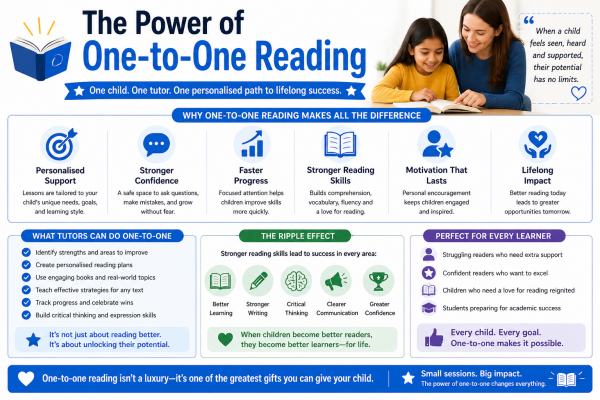
In a world where education often happens in crowded classrooms and noisy digital spaces, the quiet, focused environment of one-to-one reading stands out as something truly special. At Read With Us, we believe in the transformative power of personal attention. Our reading support model is based on a simple but powerful idea: every child deserves to be seen, heard, and supported as they learn to read.
This blog explores why one-to-one reading is so effective, how it works in practice, and what it means for the children, volunteers, and communities involved. If you're a parent, educator, volunteer, or simply someone who cares about literacy and children, we hope this in-depth article gives you insight and inspiration.
The foundation of one-to-one reading is relationship. When a child sits down with a consistent adult who is there just for them, something magical happens. They feel safe, valued, and motivated. In this setting, reading stops being a chore and becomes a moment of connection.
Children who struggle with reading often feel embarrassed or left behind. In large classrooms, they may not get the help they need. One-to-one sessions remove that pressure. There is no rush, no judgment, and no comparison. Just two people and a book. That simplicity creates space for trust, confidence, and real progress.
One-to-one reading also allows for a personalised approach. Every child learns at a different pace and has unique interests. With individual attention, volunteers can tailor the session to suit the child's reading level, mood, and curiosity. This is something group learning simply cannot provide on the same level.
Research strongly supports the benefits of individualised instruction. Studies show that one-to-one reading interventions can lead to significant improvements in word recognition, reading fluency, and comprehension. In fact, some findings suggest that these improvements are even greater than those achieved in small group or whole-class settings.
The reason is clear: children thrive when they feel seen. Personalised support helps them stay engaged and makes learning more relevant. With direct feedback, they can correct mistakes, ask questions, and develop confidence. Moreover, the emotional bond that forms between reader and child contributes to a sense of safety that is crucial for learning.
Neurologically, reading is a complex skill. It requires attention, memory, processing, and language development. When a child struggles, they often need a steady, supportive environment to strengthen these cognitive processes. One-to-one reading offers just that. It slows things down and allows the brain to build connections at its own pace.
At Read With Us, our approach is simple and effective. We recruit and train volunteers who give their time to read one-to-one with children in schools. These sessions are held regularly, usually once a week, and take place in a quiet space away from the classroom noise.
Our volunteers are carefully matched with children who would benefit most from extra support. This might be a child who has fallen behind, lacks confidence, or simply does not have access to books at home. The goal is not to replace teachers, but to complement classroom learning with a personal touch.
Volunteers are given guidance and support. They are encouraged to focus on enjoyment, not just accuracy. That means celebrating effort, sharing stories, and building a reading relationship that makes the child want to come back next time. This consistency is key. When a child knows they will see the same volunteer each week, it creates a sense of continuity and trust.
Each session is different because each child is different. But there are some core elements that make these moments so effective.
1. Warm Welcome: The session begins with a friendly greeting. This sets the tone and helps the child relax.
2. Book Choice: Wherever possible, the child chooses the book. This gives them ownership and encourages engagement.
3. Shared Reading: The adult and child take turns reading. Volunteers may help with tricky words, explain new vocabulary, or just listen patiently.
4. Conversation: Talking about the story is as important as reading it. Volunteers ask questions, make connections, and encourage the child to share their thoughts.
5. Positive Feedback: Praise is specific and sincere. Rather than just saying "good job," volunteers might say, "I noticed you didn’t give up on that long word" or "You read that sentence with great expression."
6. Closing and Looking Ahead: Sessions end on a high note, often by looking forward to the next meeting or discussing what they’ll read next.
This structure provides both stability and flexibility. It adapts to the child’s needs while keeping the focus on enjoyment and growth.
Nothing captures the value of one-to-one reading better than the voices of those who experience it firsthand. At Read With Us, we’ve worked with children who began the year unable to read even simple sentences and, within months, were picking up books with confidence and curiosity. One such child, a Year 3 student named Ayaan, barely spoke during his first session. But after six weeks with the same volunteer, he began initiating conversation, asking questions about the story, and reading entire pages on his own.
Another child, Mia, had recently moved to the UK and was still developing her English language skills. One-to-one reading gave her not only language exposure but also a safe, predictable routine. Her volunteer chose bilingual books and celebrated her efforts in both languages. The bond they built helped Mia integrate more smoothly into school life.
These stories are not rare. Across our partner schools, similar transformations are happening every term. The combination of consistency, empathy, and personal attention makes one-to-one reading a powerful force for change.