The GCSE English Language exam is a vital qualification for all students in the UK. It doesn’t just test your reading and writing abilities—it shapes how well you’ll perform in nearly every subject and future career path. Whether you want to study science, work in business, enter the creative arts, or pursue vocational training, you will need to read, write, and communicate clearly and confidently.
GCSE English Language teaches you how to:
Analyse texts in depth
Understand writer’s intentions
Structure your own arguments
Communicate your ideas with clarity and purpose
At Read With Us, we believe every student can master English with the right guidance. Visit ReadWithUs.org.uk for expert tuition, practical revision strategies, and articles that make English easy to understand.
To succeed in your exam, you must first understand how it is structured. There are two papers:
Paper 1: Explorations in Creative Reading and Writing
Section A: Reading a literature fiction extract
Section B: Descriptive or narrative writing
Paper 2: Writers’ Viewpoints and Perspectives
Section A: Reading two non-fiction texts
Section B: Writing to present a viewpoint (e.g. article, letter, or speech)
Each paper lasts 1 hour 45 minutes and assesses:
Reading skills (retrieval, analysis, evaluation, comparison)
Writing skills (content, structure, spelling, grammar, punctuation)
You’ll be marked against specific Assessment Objectives (AO1–AO6), which you must know well to target top marks.
Top students focus on building these skills:
Inference: Understanding hidden meaning
Language Analysis: Spotting word choices, metaphors, tone, and their effects
Structure: Recognising how ideas are introduced and developed
Evaluation: Judging the writer’s effectiveness and giving evidence
Comparison: Analysing similarities and differences between texts
Creative Writing: Crafting clear, engaging stories or descriptions
Persuasive Writing: Arguing a case logically with passion
SPaG: Using proper spelling, punctuation, and grammar throughout
To analyse effectively:
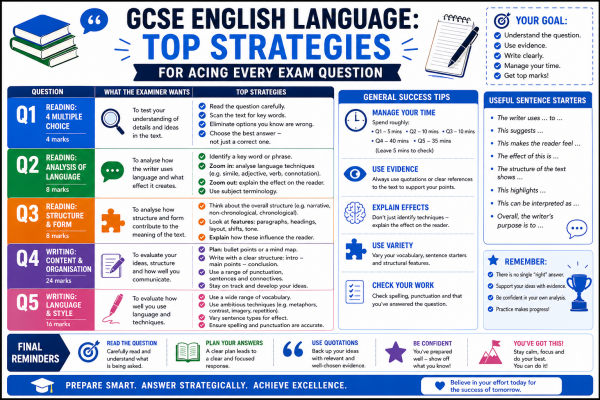
Start with the question: What does it ask you to focus on?
Highlight relevant parts of the text
Use the PEEZL method: Point, Evidence, Explain, Zoom-in, Link
Always explain why a technique is used and how it affects the reader
Example: If the writer uses a metaphor like "the wind punched his chest," ask: Why that verb? What feeling does it evoke?
Section A - Reading Fiction
Read the whole passage once, then again with a pen in hand
Annotate for language, tone, mood, and structure
Answer all four questions in order, giving full explanations
Section B - Descriptive/Narrative Writing
Spend 5 minutes planning
Choose descriptive if you’re good at painting pictures with words
Choose narrative if you enjoy building characters and stories
Start with a hook: dialogue, action, or description
Focus on imagery, structure, and emotion. Don’t forget to proofread.
Section A - Comparing Non-Fiction
Read both texts fully, noting the tone and perspective
Look for similarities and differences in attitudes and methods
Use comparative phrases (However, Similarly, Unlike)
Section B - Viewpoint Writing
Know your formats: articles, speeches, letters, essays
State your opinion early and clearly
Use persuasive techniques: repetition, rhetorical questions, facts, emotive language
Use paragraphs for structure and impact
For high marks:
Use sensory language: sight, sound, smell, touch, taste
Vary sentence lengths and structure
Avoid clichés—be original
Use similes, metaphors, and alliteration carefully
Planning and editing your work is just as important as writing it.
For the summary question:
Identify what the question is asking (usually differences or similarities)
Stick to facts only — no opinions
Don’t quote unless needed
Use your own words
Write clearly and avoid repetition.
Compare by asking:
What are the writers’ viewpoints?
What methods do they use to convey their ideas?
How are their tones or perspectives similar/different?
Make your comparison constant — don’t write about one text and then the other. Cross-reference throughout.
Stick to a strict schedule:
Spend no more than 15 minutes reading the text
Spend 45 minutes on Section A (Reading)
Spend 45 minutes on Section B (Writing)
Leave 5–10 minutes for proofreading
Practice with a timer to build exam speed and accuracy.
Avoid these:
Misreading the question
Writing without structure
Using too many quotes without analysis
Forgetting SPaG
Rushing the ending
Checklists and practice papers can help you fix weak areas.
Improve your vocabulary by:
Reading newspapers, fiction, and non-fiction
Keeping a word journal
Using new words in writing tasks
Learning synonyms and connotations
A rich vocabulary helps you express ideas precisely and creatively.
Tips:
Watch out for common grammar mistakes
Learn how to use punctuation effectively
Proofread your writing aloud
Practice editing other people’s work
Spelling, punctuation and grammar are worth 16 marks — don’t waste them.
Use past papers weekly
Break down each question type and practise it alone
Read high-quality texts regularly
Watch video explainers (e.g. ReadWithUs resources)
Use apps and flashcards for vocabulary and techniques
Consistency is key.
Top tools:
ReadWithUs.org.uk – expert blogs and resources
BBC Bitesize
Seneca Learning
Mr Bruff (YouTube)
CGP Revision Guides
Use a mix of reading, watching, writing, and testing for best results.
Pack everything the night before
Eat a good breakfast
Arrive early and stay calm
Skim through all questions first
Plan writing answers before you start
Proofread every piece of writing
Confidence comes from preparation.
Q: What grade do I need to pass?
A: Grade 4 is a standard pass. Grade 5 is a strong pass.
Q: How can I revise faster?
A: Use practice papers and active recall — not just reading notes.
Q: What if I fail?
A: You can resit in November or the following summer.
Q: Where can I get help?
A: Visit ReadWithUs.org.uk for personalised support and tutoring.
GCSE English Language is a challenging subject, but one that you can master with the right plan. Understand the exam format, practise each question type regularly, and focus on your weakest areas.
Visit ReadWithUs.org.uk for expert tips, resources, and guidance tailored to students just like you. We believe every learner can succeed with the right support.
Start revising today, and give yourself the best chance to ace your GCSE English Language exam.
Discover more tips and revision strategies at ReadWithUs.org.uk