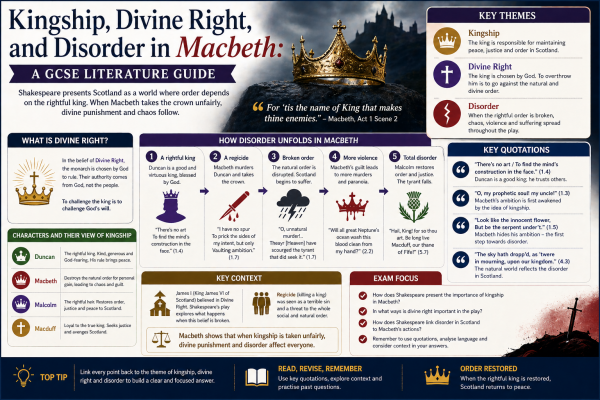
Macbeth: Kingship, Divine Right, and Disorder (GCSE Literature Guide)
In Macbeth, Shakespeare shows what happens when a country is led well and what happens when it is led badly. The play is not only about one man’s ambition. It is also about power, responsibility, and legitimacy. Shakespeare explores three linked ideas:
Kingship — what a good king should be like
Divine Right — the belief that a king’s authority comes from God
Disorder — the chaos that spreads when the rightful order is broken
These ideas help explain why Duncan’s death matters so much and why Scotland suffers under Macbeth.
1) What is "good kingship” in the play?
A good king is not just someone who wears a crown. In Shakespeare’s message, a good king should:
protect people from harm
act fairly and calmly
reward loyalty and service
bring stability to the country
put the nation before personal desires
A good king creates a society where people feel safe. They can work, travel, and speak without fear. A bad king creates the opposite. People hide what they think. They expect violence. They stop trusting each other.
This matters because Shakespeare shows that leadership is not a private matter. It affects everyone.
2) What is the Divine Right of Kings?
In the time Shakespeare wrote, many people believed that a rightful king ruled by God’s permission. This idea is called the Divine Right of Kings. It suggests:
the king’s role is sacred
the king is meant to keep order in the land
to attack the king is also to challenge God’s design
a stolen crown cannot bring peace
This belief changes how we understand Macbeth’s crime. Macbeth does not only remove a political leader. He breaks a religious and moral expectation. That is why the play links Duncan’s murder to fear and disorder across Scotland.
3) Disorder: what does it look like in Macbeth?
After Duncan is killed, Scotland feels "wrong”. Shakespeare shows disorder in several ways:
Disorder in nature
The play includes reports of unusual natural events. Shakespeare uses this to suggest the world reacts when the rightful ruler is removed. Nature becomes a sign that something has gone against what is right.
Disorder in society
Scotland becomes a place where people whisper instead of speaking openly. Trust collapses. The country feels unsafe. People worry that violence can happen at any time.
Disorder inside Macbeth
Macbeth also becomes unstable. His mind is full of fear. He struggles to rest. He becomes obsessed with threats. This shows that disorder is not only outside him. It grows inside him as well.
4) Duncan as the image of rightful rule
Duncan is presented as the lawful king of Scotland. He is linked to order, reward, and public honour. When he praises others, it shows he values service. When he trusts his nobles, it shows the country is meant to run through loyalty and duty, not fear.
Duncan does make mistakes. He misjudges people. He is too trusting. But Shakespeare still sets him up as the rightful king because legitimacy matters in this play. Duncan represents the kind of leadership that keeps Scotland stable.
So, when Macbeth kills Duncan, Shakespeare wants the audience to feel it is not only a personal betrayal. It is an act that damages the whole nation.
5) Macbeth’s kingship: power without security
Macbeth becomes king through violence, not through lawful succession. This decision poisons everything that follows. Macbeth’s rule is built on one problem: he knows he does not deserve the throne. That single fact shapes his whole reign.
Once Macbeth is king, he changes quickly:
he stops trusting people
he looks for enemies everywhere
he uses violence to stay in control
he becomes isolated from friendship and support
A strong king does not need constant fear to stay in power. Macbeth does. That makes him a tyrant rather than a protector. Shakespeare uses Macbeth to show that a ruler who grabs power for himself cannot create peace for others.
Macbeth’s actions also show a pattern. One wrong choice leads to another. To protect the throne he stole, he feels forced to commit more crimes. Each act increases disorder, both in Scotland and in his mind.
6) The witches: temptation and moral confusion
The witches matter because they shape Macbeth’s thinking. They speak in a way that twists meaning. They offer Macbeth a picture of power, but they do not offer him a moral path.
The witches represent a world where:
language is unclear
good and bad are mixed up
ambition is encouraged without limits
However, Macbeth is still responsible. The witches do not physically make him commit murder. Macbeth chooses to turn desire into action. That is important for exam answers because it keeps Macbeth accountable for what he becomes.
7) Lady Macbeth: rejecting conscience, then collapsing
Lady Macbeth pushes Macbeth toward the murder of Duncan. She challenges his confidence and attacks his hesitation. Early on, she seems determined and fearless.
But Shakespeare does not present this strength as healthy. Lady Macbeth tries to shut down natural human feelings like guilt and empathy. She sees kindness as weakness.
Later, she breaks. Guilt returns in a stronger form. She cannot simply "switch off” the consequences of what she helped begin. Through Lady Macbeth, Shakespeare suggests that moral order matters because human minds cannot carry wrongdoing forever without damage.
8) Malcolm and the repair of Scotland
Malcolm is important because he represents lawful succession. He is Duncan’s heir. He becomes a symbol of restoration. When Malcolm returns, the play moves toward stability again.
Malcolm also shows that leadership needs judgement. He tests loyalty and builds support rather than ruling through terror. This is the opposite of Macbeth’s approach. Macbeth controls by fear. Malcolm leads through legitimacy and unity.
By the end, Shakespeare suggests that Scotland can heal, but only after a great cost. Order can return, but disorder leaves scars.
9) How to write this in the exam
A strong GCSE paragraph usually does five things:
Make a clear point
Refer to a moment in the play
Explain what Shakespeare suggests
Link to context (Divine Right beliefs)
Explain the effect on the audience
Model paragraph
Shakespeare shows that a king should bring stability, not fear. Duncan’s death matters because he is the rightful ruler, and removing him breaks the expected order of society. After Macbeth takes the throne, Scotland becomes unsafe and suspicious, which suggests that unlawful power leads to national suffering. In Shakespeare’s time, many people believed a king ruled by God’s authority, so killing a king would seem not only criminal but also sinful. Shakespeare uses Macbeth’s reign to warn that ambition without morality creates disorder in the country and in the human mind.