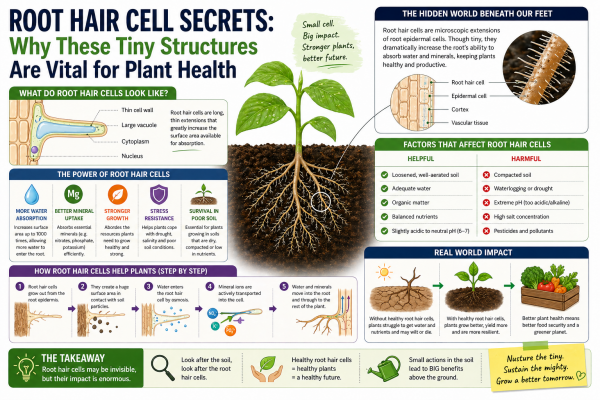
Root Hair Cell Secrets: Why These Tiny Structures Are Vital for Plant Health
Plants cannot move to search for richer ground. If soil is sandy, dry, or low in nutrients, the plant still has to survive where it is. That is why roots are built for efficient uptake. One of the most important parts of this system is the root hair cell.
Root hair cells are found on young roots. Each one forms a long, thin extension called a root hair. These hairs push into the tiny spaces between soil particles. This gives the plant a much bigger area to absorb water and mineral ions. In poor soil, that extra contact can be the difference between weak growth and healthy growth.
Encyclopedia Britannica
+2
Lumen Learning
+2
What exactly is a root hair cell?
A root hair is not a separate organ. It is an outgrowth of an epidermal cell on the root surface. Root hairs form a little way back from the root tip, in the region where cells start to mature and specialise.
Encyclopedia Britannica
+1
Root hairs are short-lived, but plants produce many of them continuously as the root grows. This keeps the plant’s absorbing zone active and effective.
Why "poor soil” is such a problem
Poor soil usually has at least one of these issues:
Low water (fast draining sand, dry ground, heat)
Low nutrients (not enough nitrate or phosphate)
Compacted structure (few air gaps, hard for roots to explore)
Unhelpful pH (nutrients become harder to take up)
In these conditions, even a plant with strong leaves cannot do much. Leaves can only make food if the plant has enough water and minerals coming in through the roots. Root hair cells help the plant keep that supply going.
Secret #1: Surface area is everything
The biggest advantage of root hair cells is simple: they increase surface area.
A smooth root has limited contact with soil. A root covered with root hairs touches far more soil particles and far more water films. That larger contact area increases the rate of uptake.
Lumen Learning
+1
Think of it like this:
A plain root is like a flat sponge.
A root with hairs is like a sponge with lots of tiny fibres.
Those fibres reach more water and hold contact for longer.
Secret #2: How water enters (osmosis)
Most water enters through root hair cells by osmosis.
Osmosis is the movement of water across a partially permeable membrane from a place with more available water to a place with less available water. In roots, the cell contents often have more dissolved substances than the surrounding soil water. Water then moves into the root hair cell.
Save My Exams
+1
In dry soil, the water around soil particles can be very limited. Root hairs help because:
they reach into tiny spaces where water sits
they create more entry points
they increase the chance of absorbing small amounts of water
This matters for plant health because water is needed for:
transporting minerals upward
keeping cells firm (turgor)
photosynthesis
cooling the plant through transpiration
Secret #3: How minerals enter (active transport)
Mineral ions are a different challenge. In poor soil, mineral concentrations can be very low. Plants often need to move ions into the root even when the concentration outside is lower than inside. That requires active transport.
Active transport:
uses energy from respiration
uses carrier proteins in the cell membrane
allows uptake against a concentration gradient
Save My Exams
+2
Save My Exams
+2
This is why root hair cells are often described as having many mitochondria. Mitochondria release the energy needed for active transport.
Save My Exams
+1
In real plant growth, this helps the plant secure key minerals that support healthy development, especially in nutrient-poor ground.
Secret #4: Their structure is built for the job
Root hair cells have a set of features that match their role:
Long, thin hair
This creates a huge surface area and allows the root to make contact with more soil water and dissolved minerals.
Save My Exams
+1
Thin barrier to cross
Root hairs are designed for fast movement of water into the cell. The shorter the distance, the quicker the uptake can happen.
Save My Exams
Strong energy supply
Active transport needs energy, so root hair cells are linked to high respiration demand.
Save My Exams
+1
Large vacuole
A large vacuole supports water movement and helps the cell maintain internal conditions needed for uptake.
Wikipedia
These points are also GCSE-friendly because they clearly show "structure supports function”.
Secret #5: Root hairs help the whole plant, not just the root
When root hair cells absorb more water and minerals, the benefits spread through the plant:
Better leaf growth because cells can expand and stay firm
Stronger photosynthesis because water is a raw material
Improved transport because xylem flow depends on water supply
Faster recovery after heat or dry periods
Healthier colour and growth because minerals support enzymes and chlorophyll
So even though root hairs are tiny, they affect almost every part of plant health.
Secret #6: Why they matter even more in poor soil
In rich soil, minerals and water are easier to access. In poor soil, the plant must work harder. Root hairs become vital because they:
Increase contact when resources are scarce
Improve uptake speed when the plant cannot afford slow growth
Support young plants that have small root systems
Help plants compete when many roots share the same limited resources
This is why stressed plants often show growth problems above ground first. The real cause is often below ground: not enough water or minerals entering the plant.
Simple ways to support healthy root hairs (gardening angle)
If you are writing for gardeners, these tips are practical and safe:
Avoid constant overwatering: roots need oxygen too
Do not overuse strong fertilisers: high salt levels can damage delicate root hairs
Improve soil structure with compost or organic matter
Water steadily rather than extreme dry-then-flood cycles
Reduce root disturbance: root hairs are fragile and break easily
Better root hair health usually means better plant health.
Conclusion
Root hair cells are one of the main reasons plants can survive in weak soil. They increase surface area, help water enter by osmosis, and help minerals enter using active transport when levels are low.
Save My Exams
+2
Save My Exams
+2
If your goal is strong, steady plant growth, you cannot ignore what happens at the root surface. Root hair cells may be tiny, but they are a major part of a plant’s survival system.