Write For Us

We Are Constantly Looking For Writers And Contributors To Help Us Create Great Content For Our Blog Visitors.

Contribute
Root Hair Cells Explained: How They Help Plants to Grow in Poor Soil
elearning, GCSE, GCSE Biology

Root Hair Cells Explained: How They Help Plants to Grow in Poor Soil


2025-12-24 22:41:49 |    0

Introduction

Plants are essential to life on Earth. They provide food, oxygen, shelter, and raw materials for countless organisms, including humans. For plants to grow, they require water, mineral nutrients, sunlight, and suitable environmental conditions. Among these, the availability of water and nutrients from the soil is one of the most critical factors influencing plant growth and survival. However, not all soils are fertile. Many plants grow in poor soil, which may lack essential nutrients, retain little water, or have unsuitable physical properties.

Despite these challenges, plants have evolved highly effective adaptations that allow them to survive and grow even in unfavourable soil conditions. One of the most important of these adaptations is the presence of root hair cells. These specialized cells play a crucial role in absorbing water and mineral ions from the soil and are especially important in poor soil environments.

This article provides a detailed and comprehensive explanation of root hair cells, focusing on their structure, functions, adaptations, and significance in helping plants grow in poor soil. The content is designed for students studying GCSE Biology, A-Level Biology, and equivalent curricula, as well as parents, tutors, and educators using learning platforms such as Read With Us to support academic progress.


What Are Root Hair Cells?

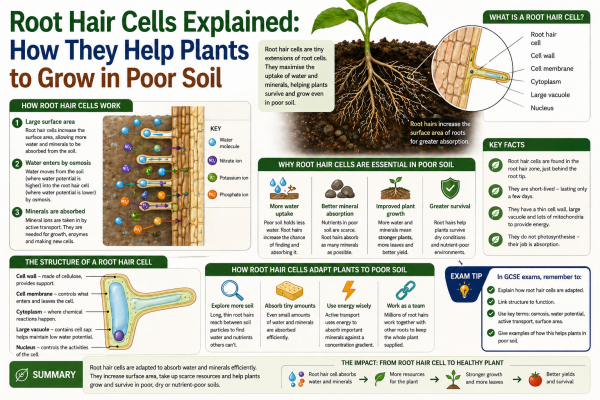
Root hair cells are specialized cells found on the surface of plant roots. They develop from the epidermal layer of the root and appear as fine, hair-like extensions that grow outward into the surrounding soil. Each root hair is a single cell, not a group of cells, and can be several times longer than the width of the root itself.

Root hair cells are located just behind the root tip, in a region where cells have fully differentiated. This positioning allows them to make direct contact with soil particles, water films, and dissolved mineral ions.

Although root hair cells are microscopic and short-lived, they are produced in extremely large numbers. Together, they form an extensive network that significantly increases the surface area of the root system. This increased surface area is essential for efficient absorption, particularly in poor soils where resources are limited.


Why Poor Soil Is a Challenge for Plant Growth

Poor soil refers to soil that lacks one or more of the conditions required for healthy plant growth. Common characteristics of poor soil include:

  • Low mineral nutrient content

  • Poor water retention or excessive drainage

  • Compacted structure with limited air spaces

  • Extreme pH levels (too acidic or too alkaline)

  • Low organic matter

In such soils, plants struggle to obtain enough water and nutrients to support essential processes such as photosynthesis, respiration, and growth. Without effective adaptations, plants growing in poor soil would show stunted growth, poor health, and reduced survival rates.

Root hair cells help overcome many of these limitations by improving the plant’s ability to absorb scarce resources efficiently.


Structure of Root Hair Cells

The structure of a root hair cell is closely linked to its function. Each component of the cell is adapted to maximize water and mineral absorption.

Thin and Permeable Cell Wall

The cell wall of a root hair cell is thin and freely permeable. This allows water and dissolved mineral ions to pass through easily without significant resistance. A thin cell wall shortens the diffusion distance, increasing the rate of absorption.

Cell Membrane with Transport Proteins

The cell membrane is selectively permeable and contains a wide range of transport proteins. These proteins enable the cell to control which substances enter and leave. They are especially important for absorbing mineral ions through active transport when soil concentrations are low.

Large Central Vacuole

The vacuole occupies most of the volume of the root hair cell. It contains cell sap, a concentrated solution of salts and sugars. This low water potential inside the vacuole draws water into the cell by osmosis, even in dry or poor soil conditions.

Elongated Shape

The long, thin shape of the root hair greatly increases the surface area to volume ratio. This adaptation allows maximum contact between the cell and the surrounding soil.

Cytoplasm and Nucleus

The cytoplasm contains enzymes and mitochondria needed for respiration and active transport. The nucleus controls cell growth, metabolism, and the production of proteins involved in absorption.


How Root Hair Cells Absorb Water

Water absorption is one of the primary functions of root hair cells. This process occurs mainly through osmosis.

Osmosis is the movement of water molecules from an area of higher water potential to an area of lower water potential across a semi-permeable membrane. In the soil, water usually has a higher water potential than the cell sap inside the root hair cell. As a result, water moves into the cell through the cell membrane.

In poor soil conditions where water availability is low, root hair cells maintain a low water potential by accumulating solutes in their vacuole. This ensures that water continues to enter the cell even when the soil is relatively dry.

Once inside the root hair cell, water moves across the root cortex and into the xylem, where it is transported to the rest of the plant.


Mineral Ion Absorption in Poor Soil

Plants require mineral ions for healthy growth and development. These include:

  • Nitrates for protein synthesis

  • Phosphates for energy transfer and DNA

  • Potassium for enzyme activation

  • Magnesium for chlorophyll formation

  • Calcium for cell wall stability

Poor soils often contain low concentrations of these essential minerals. Root hair cells absorb mineral ions using two main mechanisms: diffusion and active transport.

Diffusion

When mineral ions are present in higher concentration in the soil than inside the root hair cell, they move into the cell by diffusion. This process does not require energy.

Active Transport

In poor soil, mineral ion concentrations are often lower outside the cell than inside. Root hair cells use active transport to move ions against the concentration gradient. This process requires energy from ATP, produced during respiration in mitochondria.

Active transport allows plants to survive in nutrient-deficient environments by ensuring that essential minerals are absorbed efficiently.


Ion Exchange and Soil Interaction

Many mineral ions are bound to soil particles and are not freely available in soil water. Root hair cells release hydrogen ions into the soil. These hydrogen ions displace mineral ions from soil particles, making them available for absorption.

This process, known as ion exchange, is especially important in poor soils where nutrients are tightly bound and difficult to access.


Adaptations of Root Hair Cells for Poor Soil Conditions

Root hair cells have several adaptations that make them particularly effective in poor soil environments.

Increased Surface Area

Thousands of root hairs grow on a single root, greatly increasing the total surface area available for absorption.

Close Contact with Soil Particles

Root hairs grow between soil particles, allowing them to absorb water and minerals directly from thin films of moisture surrounding the particles.

Continuous Replacement

Root hair cells are short-lived but are continuously replaced as the root grows. This ensures that new root hairs are always available in fresh soil regions.

Enhanced Transport Activity

In nutrient-poor soils, plants often increase the activity of transport proteins in root hair cells to improve mineral uptake.


Root Hair Cells and Transport Pathways

After water and mineral ions enter the root hair cell, they move through the root to reach the xylem. This occurs via two main pathways:

Apoplastic Pathway

Movement through cell walls and intercellular spaces without crossing cell membranes.

Symplastic Pathway

Movement through the cytoplasm of cells connected by plasmodesmata.

Root hair cells serve as the entry point for both pathways, making them essential for internal transport within the plant.


Role of Root Hair Cells in Photosynthesis

Photosynthesis depends on minerals absorbed by root hair cells. Magnesium is required for chlorophyll synthesis, while nitrogen is essential for enzymes involved in photosynthesis.

In poor soil conditions, reduced mineral availability can limit photosynthesis. Root hair cells help maintain adequate nutrient levels, ensuring efficient photosynthesis and healthy plant growth.


Importance of Root Hair Cells in Seedling Establishment

Seedlings are particularly vulnerable during early growth stages. Their roots are small and undeveloped, making absorption difficult in poor soil.

Root hair cells develop rapidly in young roots and provide the primary means of water and nutrient uptake. Without effective root hair function, seedlings may fail to establish and die.


Root Hair Cells and Environmental Stress

Root hair cells help plants cope with environmental stresses such as:

  • Drought, by improving water uptake

  • Salinity, by regulating ion absorption

  • Compacted soil, by maximizing contact with available pores

These responses improve plant resilience and survival in challenging environments.


Genetic Control of Root Hair Cell Development

The development of root hair cells is controlled by specific genes. Environmental factors such as nutrient deficiency can influence gene expression, leading to increased root hair length and density.

Plants growing in poor soil often show genetic adaptations that enhance root hair development, improving nutrient uptake efficiency.


Symbiotic Relationships Involving Root Hair Cells

Root hair cells interact with beneficial microorganisms in the soil.

Mycorrhizal Fungi

These fungi form symbiotic relationships with plant roots, extending the effective root system and improving phosphorus uptake.

Nitrogen-Fixing Bacteria

In legumes, bacteria convert atmospheric nitrogen into forms plants can use. Root hair cells absorb these nutrients, supporting growth in nitrogen-poor soils.


Importance in Agriculture and Sustainability

Understanding root hair cells has important agricultural applications. Crops with efficient root hair systems require less fertilizer and water, reducing costs and environmental impact.

This knowledge supports sustainable farming practices and helps improve food security in regions with poor soil quality.


Educational Importance for Students

Root hair cells are a core topic in biology education. They connect several key concepts:

  • Cell specialization

  • Transport mechanisms

  • Plant adaptation

  • Ecosystem interactions

Mastering this topic improves exam performance and scientific understanding.


Practical Learning Activities

  • Observing root hairs under a microscope

  • Growing plants in different soil types

  • Comparing growth rates in nutrient-rich and poor soils

These activities reinforce theoretical knowledge through practical experience.


Common Exam Questions and Study Tips

Students should be able to:

  • Describe the structure of root hair cells

  • Explain how structure relates to function

  • Discuss adaptations for poor soil

  • Apply knowledge to unfamiliar scenarios

Clear diagrams and precise explanations are essential in exam answers.


Frequently Asked Questions

Why are root hair cells short-lived?

They are replaced as roots grow to maintain efficient absorption.

Can plants survive without root hair cells?

Most plants would struggle, especially in poor soil conditions.

Do all plants have root hair cells?

Most land plants do, although structure and density may vary.


Glossary of Key Terms

Root Hair Cell: A specialized root cell for absorption
Osmosis: Movement of water across a semi-permeable membrane
Active Transport: Energy-requiring movement of ions
Vacuole: Storage organelle in plant cells
Mycorrhiza: Symbiotic association between fungi and roots


Conclusion

Root hair cells are essential structures that enable plants to grow and survive in poor soil conditions. Their specialized structure and functions allow efficient absorption of water and mineral nutrients, support photosynthesis, promote growth, and enhance resistance to environmental stress.

Understanding root hair cells provides valuable insight into plant biology, agriculture, and sustainability. For students, this topic builds a strong foundation for further study in biology and environmental science, making it a key area of learning within the curriculum.

Comments