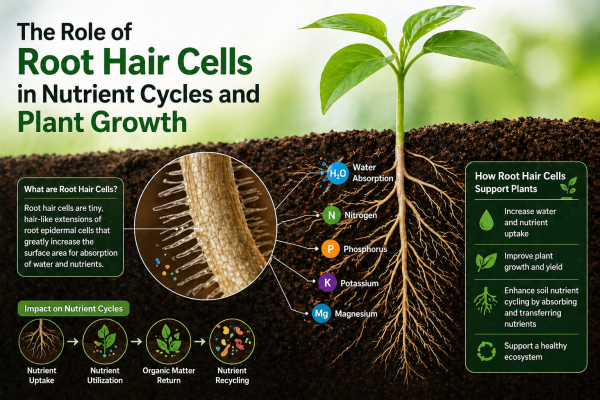
Plants do not "eat” in the way animals do. They build their food through photosynthesis, but they still depend on the soil for water and mineral nutrients. If a plant cannot take in enough minerals, it may grow slowly, turn pale, or fail to produce healthy leaves and flowers. One of the most important parts of this uptake system is the root hair cell.
Root hair cells are tiny, but their impact is huge. They help plants absorb minerals that drive growth, and they also help keep nutrient cycles moving through ecosystems. In this blog, you will learn what root hair cells do, how they support plant growth, and how they connect to wider nutrient cycles such as the nitrogen and phosphorus cycles.
Root hair cells are specialised cells found on young roots, usually just behind the root tip. Each root hair cell forms a long, thin extension called a root hair. These hairs push into small gaps between soil particles.
This matters because nutrients and water are not evenly spread through soil. They sit in thin water films around particles and in tiny spaces filled with air and moisture. Root hairs increase contact with these spaces, making uptake more efficient.
Root hair cells are designed for one main job: increase uptake. They do this through several key features:
Very large surface area: The hair-like extension creates more contact with soil.
Thin barrier for movement: Water and dissolved ions can move into the cell more easily.
High energy supply: Mineral uptake often needs active transport, which uses energy.
Close contact with soil water: Root hairs reach where the resources are.
These adaptations are not "extra.” In many soils, especially poor soils, plants would struggle without them.
Plant growth depends on three connected needs:
Water (for transport, cell turgor, and photosynthesis)
Mineral ions (for proteins, enzymes, chlorophyll, DNA, and more)
A steady supply over time (not just one-time intake)
Root hair cells support all three.
Plant cells grow largely by taking in water. When water enters cells, it creates turgor pressure. This pressure keeps stems firm and pushes cells to expand. If water is limited, the plant becomes flaccid and growth slows.
Minerals are needed to build the chemicals of life. Without them, the plant can still photosynthesise for a while, but it cannot use that sugar properly to make new cells and structures.
Plants grow over weeks and months. They need ongoing mineral intake to maintain healthy leaves, replace damaged tissue, and develop flowers, seeds, or fruit. Root hair cells help keep that flow constant.
Mineral ions can enter roots in two main ways:
If a mineral is more concentrated in soil water than inside the root hair cell, it can move in without extra energy.
Often, minerals are low in soil water. Plants still need them, so they move ions into the root hair cell against a concentration difference. This requires:
carrier proteins in the cell membrane
energy from respiration (ATP)
This is one reason root hair cells are linked to high metabolic activity. The plant is spending energy to pull in nutrients that it needs for growth.
Nutrient cycles describe how elements move through living organisms and the environment. Root hair cells matter because they are a major "entry point” for nutrients into the living world.
Think of them as a gateway:
Nutrients in soil → absorbed by root hair cells → enter plants → move through food webs → return to soil through waste and decay
Without efficient uptake, nutrients would remain in soil and would not flow effectively into ecosystems.
Below are the big cycles where root hair cells play a key role.
Nitrogen is essential for:
amino acids (proteins)
enzymes
DNA
Plants cannot use nitrogen gas in the air directly. They mainly absorb nitrogen as nitrate ions from soil water.
Nitrates appear in soil through natural processes:
decomposition of dead organisms and waste (releasing ammonia)
conversion of ammonia into nitrates by nitrifying bacteria
fertilisers adding nitrates or ammonia compounds
nitrogen fixation by bacteria (often in legumes)
Nitrate ions are dissolved in soil water. Root hairs increase the chance of contact with these ions and help pull them into the plant. In many soils, nitrates move easily with water, but can also be washed away (leaching). Root hairs help plants capture nitrates before they are lost.
When plants absorb nitrates, nitrogen moves into plant proteins. Then:
herbivores eat plants
predators eat herbivores
decomposers return nitrogen to soil
bacteria convert nitrogen into forms plants can use again
Root hair cells start this chain by moving nitrates from soil into living tissue.
Phosphorus is needed for:
ATP (energy transfer)
DNA and RNA
cell membranes
Unlike nitrates, phosphate ions are often less available in soil because they can bind to soil particles. This makes phosphorus a common limiting nutrient in many environments.
Because phosphate is not always freely moving in soil water, plants often rely heavily on surface contact and active transport. Root hairs help by:
increasing surface area in the soil
reaching more micro-spaces where phosphate may be present
improving overall uptake rate
In low-phosphate soils, root hair development can strongly influence plant health.
Root hair cells do not absorb carbon dioxide (leaves do), but they support carbon cycling indirectly by supporting plant growth.
When root hair cells bring in water and minerals:
photosynthesis increases (healthy leaves)
plant biomass increases (more carbon stored in tissue)
plants produce roots, stems, and leaves that later decay
decomposers break down dead matter and return carbon to soil and air
So even though root hairs do not "take in carbon,” they help plants grow, and plant growth is a major driver of carbon movement through ecosystems.
Soil is alive. Around roots, there is a busy zone called the rhizosphere. It includes:
bacteria
fungi
protozoa
tiny invertebrates
Root hair cells influence this zone because plants release small amounts of sugars and compounds from roots. These chemicals feed microbes. In return, microbes can:
break down organic matter
release mineral ions into soil water
improve nutrient availability
This creates a feedback loop:
root hairs increase uptake
plants grow more
plants feed soil microbes more
microbes release nutrients more
uptake becomes easier again
This relationship is one reason healthy soils support better plant growth than sterile soils.
Many plants form partnerships with fungi called mycorrhiza. Fungi spread thin threads through soil that can reach beyond the root hair zone. This is especially helpful for phosphate uptake.
Root hair cells still matter in these partnerships because they:
increase the contact area at the root surface
help maintain a strong absorption zone
support the plant’s ability to provide sugars to the fungi
In poor soils, plants often rely on both root hairs and fungal partners to maintain nutrient flow.
If root hair cells cannot work well, the plant may show signs of nutrient problems, such as:
yellow leaves (often linked to nitrogen shortage)
slow growth and weak stems
poor root development
low flower or fruit production
reduced resistance to stress (heat, drought, pests)
In ecosystems, weak uptake also slows nutrient cycling because fewer nutrients move into plant biomass and food chains.
Root hair cells play a major role in both plant growth and nutrient cycles. They are not just "extra hairs.” They are a key system that helps plants:
absorb water and mineral ions effectively
take in nitrates for proteins (nitrogen cycle)
take in phosphates for energy and DNA (phosphorus cycle)
support stronger plant growth, which drives wider ecosystem cycles
In simple terms: root hair cells help nutrients move from soil into life. Without them, plants would grow poorly, and nutrient cycles would slow down.