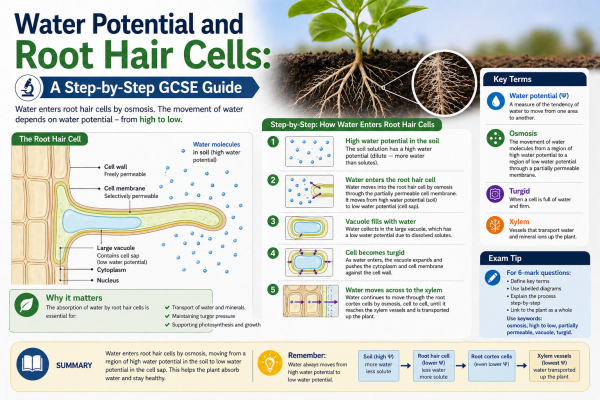
Water is essential for plant survival. It keeps cells firm, moves minerals, and supports photosynthesis. One key GCSE idea explains how water moves into plants: water potential. Root hair cells are the first major place where this water enters.
This guide explains water potential in a clear, step-by-step way, and links it directly to root hair cells and osmosis.
Water potential is a measure of how likely water is to move from one place to another.
Water moves from higher water potential to lower water potential.
Water potential is shown by the symbol Ψ (psi).
The unit is usually kPa (kilopascals) in GCSE questions.
A simple rule to remember:
Pure water has the highest water potential (0 kPa).
Any solution with dissolved substances has a lower (more negative) water potential.
So, the more solute there is (like salts or sugars), the more negative the water potential becomes.
GCSE biology uses 0 kPa as a reference point.
Pure water = 0 kPa
A solution (with solutes) = negative value (for example, −200 kPa)
This helps you compare two places. Water will always move towards the more negative value.
Osmosis is the movement of water through a partially permeable membrane from:
higher water potential to lower water potential
That membrane is important. In plants, the membrane is the cell membrane of root hair cells.
So, when you see "water potential” in a question, your brain should connect it to:
osmosis
partially permeable membranes
movement of water into or out of cells
Root hair cells are special cells on young roots. Each cell grows a thin extension called a root hair. This matters because:
it gives a large surface area
it touches more water between soil particles
it speeds up absorption
Root hair cells are designed to absorb:
water (mainly by osmosis)
mineral ions (often by active transport)
Water moves into a root hair cell because of a water potential gradient.
Soil water has some dissolved minerals, but usually not as concentrated as the cell sap.
Root hair cell cytoplasm and vacuole contain dissolved substances (salts, sugars).
This makes the root hair cell’s water potential more negative than the soil water.
Water moves:
from soil (higher water potential)
into root hair cell (lower water potential)
by osmosis
through the cell membrane
Key sentence for exams:
Water enters root hair cells by osmosis because the water potential inside the cell is lower than in the soil.
Water does not stop at the root hair cell. It moves deeper into the root and then into the xylem.
A GCSE-friendly pathway:
Soil water enters root hair cell by osmosis
Water moves through the root cortex cells
Water enters the xylem
Water travels up the plant to leaves (transpiration pull helps)
You do not need advanced detail for GCSE, but you must show that:
water follows the water potential gradient
movement continues until it reaches xylem
When water enters a plant cell, the vacuole swells and pushes the cytoplasm against the cell wall. This creates turgor pressure.
A turgid cell is firm (good for support)
A flaccid cell is limp (plant wilts)
This matters because if soil water potential drops too low (very dry or salty soil), less water enters root hair cells. Cells lose turgor, and the plant can wilt.
Dry soil often has lower water potential than moist soil.
If soil becomes very dry, the soil water potential can become more negative than the root hair cell. If that happens, water may:
enter very slowly, or
stop entering, or
even move out of the root hair cell (in extreme cases)
This is why plants struggle in drought conditions.
If soil contains lots of salts, the soil water potential becomes very negative.
That can reduce water uptake because:
the soil water potential can become lower than the root hair cell
osmosis may move water out of the root hair cell
cells lose turgor and the plant wilts
This explains why too much fertiliser can damage plants. Fertiliser increases solutes in soil water.
Some GCSE papers include a simple relationship:
Ψ = Ψs + Ψp
Where:
Ψ = water potential
Ψs = solute potential (always negative)
Ψp = pressure potential (can be positive in turgid cells)
If your exam board does not require the equation, you can still use the concept:
more solute → lower water potential
more pressure in the cell → raises water potential
Use this 4-line structure:
State the direction of movement
Compare water potential values
Name the process (osmosis)
Mention the membrane
Water moves from the soil into the root hair cell because the soil has higher water potential than the cell sap. The water enters by osmosis through the partially permeable cell membrane.
That is usually enough for full marks at GCSE.
Mixing up "higher” and "lower” water potential
Water moves from higher to lower (towards more negative).
Forgetting the membrane
Osmosis needs a partially permeable membrane.
Saying minerals enter by osmosis
Mineral ions often enter by active transport, not osmosis.
Only saying "water moves into roots”
Always explain why (water potential gradient).
Soil water potential is −50 kPa. Root hair cell water potential is −300 kPa.
Which way will water move, and why?
Expected points:
From soil to root hair cell, because water moves from higher (−50) to lower (−300) water potential.
A farmer adds too much fertiliser. The plant wilts. Explain why.
Expected points:
Fertiliser increases solute concentration in soil water, lowering soil water potential. Less water enters root hairs, or water may move out by osmosis, so cells lose turgor.