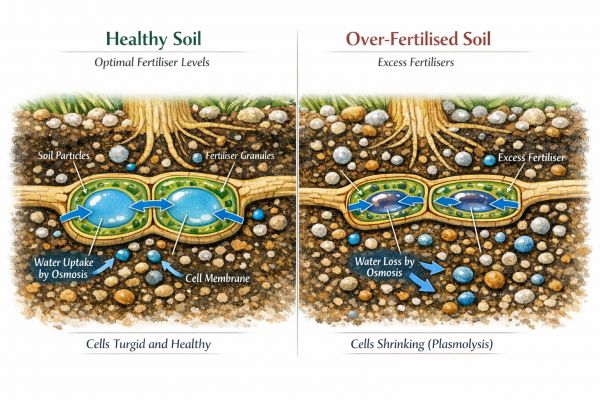
Fertilisers are often marketed as a simple promise: add nutrients, get faster growth. And in many cases, that’s true. Plants need mineral ions such as nitrates, phosphates, potassium, magnesium, and iron to build proteins, chlorophyll, enzymes, and strong tissues. When soil is poor, fertilisers can transform plant health.
But fertiliser is not magic. It is chemistry in the soil solution—and root hair cells are the first part of the plant to face that chemistry directly.
Root hair cells are specialised for absorption. They are thin, delicate, and incredibly efficient. They absorb water mainly by osmosis and absorb mineral ions often by active transport. That means fertilisers can help root hair cells do their job—by providing ions the plant needs. However, fertilisers can also make the soil solution too concentrated, reversing water movement and harming cells.
This blog breaks it down with clarity:
What root hair cells do and how they work
What fertilisers contain (NPK + micronutrients)
The benefits of fertilisers (when used correctly)
The risks (osmotic stress, root damage, nutrient imbalance, pollution)
How to use fertilisers safely and effectively
If you’re writing for GCSE Biology students, gardeners, or agriculture learners, this topic is perfect because it connects cell biology (osmosis) with real-world plant care.
Root hair cells are found on the epidermis of young roots, usually just behind the growing root tip. Each root hair is actually a single cell with a long, thin extension that pushes between soil particles.
Root hair cells absorb:
Water from the soil solution (mostly by osmosis)
Mineral ions (often by active transport)
The long hair-like extension creates a huge surface area, giving more contact with soil water and dissolved nutrients. Without root hairs, plants would absorb water and minerals much more slowly and would struggle to grow in normal soil conditions.
You’ll often see exam questions asking: "Explain how root hair cells are adapted for absorption.” These adaptations also explain why fertiliser can help or harm.
Large surface area: long projection increases absorption rate
Thin cell wall: short diffusion path for water
Large vacuole with cell sap: helps maintain a low water potential inside the cell
Partially permeable membrane: allows osmosis to occur properly
Many mitochondria: supply ATP for active transport of mineral ions
This combination makes root hair cells extremely efficient—but also sensitive to changes in the soil solution (like sudden fertiliser concentration).
Plants do not "eat” fertiliser granules directly. Fertiliser must dissolve in the water around soil particles, forming the soil solution. This solution contains water plus dissolved ions such as:
nitrate (NO₃⁻)
phosphate (PO₄³⁻)
potassium (K⁺)
magnesium (Mg²⁺)
calcium (Ca²⁺)
iron (Fe²⁺ / Fe³⁺)
Root hair cells absorb from this soil solution. Therefore, fertiliser changes the concentration of the soil solution—and that changes water movement and ion movement.
To understand fertiliser risks, you must understand osmosis properly.
Osmosis is the net movement of water molecules through a partially permeable membrane from a region of higher water potential to a region of lower water potential.
Water moves:
from more dilute (higher water potential)
to more concentrated (lower water potential)
across a partially permeable membrane
Root hair cells rely on osmosis to absorb water. If fertiliser makes the soil solution too concentrated, water may stop entering the root—or even move out of it.
Many learners struggle with water potential, but it’s basically a way to describe how strongly water wants to move.
Pure water has the highest water potential
Adding solutes (salts, fertiliser ions) makes water potential lower
Water moves from higher water potential → lower water potential
So, when soil is dilute, water potential is higher outside the root hair cell, and water enters. When soil becomes highly concentrated (too much fertiliser), water potential outside becomes very low, and water may leave the cell.
Most fertilisers are sold as NPK mixtures:
N (Nitrogen): mainly for leaf growth, proteins, chlorophyll
P (Phosphorus): root development, ATP/energy systems, flowering
K (Potassium): enzyme function, water balance, disease resistance
Fertilisers may also supply micronutrients, needed in smaller amounts:
Mg: chlorophyll
Fe: chlorophyll formation support
Ca: cell wall stability and growth
S: amino acids/proteins
Zn, Mn, B, Cu, Mo: enzyme systems and growth regulation
A fertiliser can be a real benefit when the soil lacks these nutrients. But adding lots of ions changes osmotic conditions.
Plants need mineral ions to build essential molecules. In depleted soil, root hair cells may be "ready to absorb,” but the soil solution simply doesn’t contain enough nutrients.
Fertiliser increases the concentration of useful ions in the soil solution, so root hair cells can take them up.
Nitrates are used to make:
amino acids
proteins
enzymes
growth tissues
If a plant lacks nitrates, it may show:
stunted growth
pale or yellow leaves (chlorosis)
Correct fertiliser use can reverse those symptoms.
Root hair cells often absorb ions against a concentration gradient using active transport. This needs ATP, produced by respiration in mitochondria.
When fertiliser provides the correct ions:
carrier proteins in root hair cell membranes can transport ions efficiently
the plant can store and use nutrients as needed for growth and repair
This matters especially in fast-growing phases (seedlings, flowering, fruiting).
Fertilisers containing nitrogen and magnesium can significantly improve photosynthesis.
nitrogen supports chlorophyll and enzymes
magnesium is part of the chlorophyll molecule
With improved photosynthesis:
more glucose is produced
more biomass is built
the plant becomes stronger and more productive
This is a real, measurable benefit of correct feeding.
Phosphorus supports root growth and energy transfer. When used correctly, fertiliser can increase:
root length
number of root branches
number of root hair cells
More root hairs means:
more surface area
more absorption
stronger drought tolerance (within limits)
Potassium is linked to water balance in plants. It helps regulate stomata opening and closing (which affects transpiration).
Adequate potassium can lead to:
better water use efficiency
improved resistance to heat/drought stress
stronger overall plant health
Root hair cell uptake of potassium supports these plant-wide benefits.
This is the most important risk, and it directly involves root hair cells.
When fertiliser is applied too strongly (or too frequently), the soil solution can become very concentrated.
That causes:
soil water potential becomes lower than root hair cell water potential
water moves out of root hair cells by osmosis
cells lose turgor and become flaccid
wilting soon after fertilising
drooping leaves
slow recovery even after watering
dry-looking leaf edges in many cases
This can confuse people because it may look like the plant needs more water, but the real issue is that the soil solution is too concentrated for the roots to absorb water effectively.
Over-fertilising is often called fertiliser burn. The "burn” isn’t heat—it’s chemical/osmotic stress that damages root cells, including root hair cells.
Root hair cells:
have thin walls
have high surface area exposure
are directly in contact with soil solution
are not protected like deeper root tissues
When the soil solution becomes harsh:
root hair cells may shrink (loss of vacuole volume)
membranes can be damaged
absorption capacity reduces
Once the root hairs are damaged, even normal soil water becomes harder to absorb because the main absorption surface has been reduced.
In very concentrated solutions, plant cells can lose so much water that the cell membrane pulls away from the cell wall. This is plasmolysis.
Plasmolysis leads to:
severe loss of function
reduced nutrient uptake
potential cell death if stress continues
Even if the plant survives, recovery can be slow because new root hairs must be formed.
Plants need nutrients in balance. Adding too much of one nutrient can reduce uptake of others.
too much potassium may reduce magnesium uptake in some cases
excess nitrogen can produce soft leafy growth but weak stems
incorrect ratios can cause deficiency symptoms even when fertiliser is used
So a plant can look unhealthy not because it lacks fertiliser, but because it has the wrong nutrient balance.
Soil pH affects how available nutrients are. Some fertilisers can change soil pH over time.
In overly acidic soil: some nutrients may leach away or become unavailable
In overly alkaline soil: iron often becomes hard to absorb, causing yellowing leaves
Root hair cells may be working perfectly, but if nutrients are chemically "locked” in soil, uptake drops and deficiency symptoms appear.
In containers and indoor plants, fertiliser salts can build up because there is less natural drainage and dilution.
Symptoms:
white crust on soil surface
slow growth
leaf tip browning
poor water uptake
This is again linked to osmosis: salt build-up lowers soil water potential and makes water absorption harder.
Here’s the important balanced truth:
Some mineral uptake can make cell sap more concentrated
That can lower water potential inside root hair cells
This helps water enter by osmosis
So fertiliser can indirectly support water uptake when it increases nutrients gradually.
But once soil concentration becomes too high:
water potential outside drops too far
water movement slows or reverses
damage begins
So it’s all about dose and concentration.
Once water enters root hair cells, it travels across the root into the xylem.
Two routes are often described:
through cell walls and spaces between cells
faster, less controlled
through cytoplasm connected by plasmodesmata
more controlled, crosses membranes
At the endodermis, the Casparian strip forces water and dissolved substances to cross membranes, allowing the plant to control what enters the xylem. This is one reason plants can regulate salts to some extent—but heavy fertiliser can still overwhelm the system.
Nitrate ions dissolve easily and can be washed down through soil by rain, entering groundwater.
This is wasteful and can be harmful to ecosystems and water quality. It also means farmers may apply even more fertiliser, creating a cycle of dependency and pollution.
When fertiliser runoff enters lakes and rivers, it can cause eutrophication:
algae grow rapidly
algae block sunlight
plants below die
bacteria decompose dead matter and use oxygen
oxygen levels drop, harming fish and aquatic life
This is why correct fertiliser use matters not only for plant health but also for environmental health.
Many fertilisers are meant to be diluted. Using double the amount is not double the benefit—it can be double the osmotic stress.
Practical idea:
if you’re unsure, start with a weaker dose and observe plant response
Adding fertiliser to already dry soil increases concentration around roots instantly.
Better:
water the soil lightly first
then apply fertiliser (especially for liquid feeds)
This reduces shock to root hair cells.
Frequent light feeding keeps nutrient levels stable and reduces sudden changes in soil solution concentration.
For many plants, this approach:
supports steady growth
reduces burn risk
improves nutrient balance
Slow-release fertilisers release ions gradually, reducing the chance that the soil solution becomes extremely concentrated.
This helps protect root hair cells from sudden osmotic stress.
For potted plants:
water thoroughly until excess drains out
this helps remove built-up salts
Doing this occasionally protects root hairs and restores a healthier soil solution environment.
Organic matter like compost:
improves soil structure
holds water better
provides slow nutrient release
supports beneficial microorganisms
Healthy soil reduces the need for high chemical doses and makes root hair cell absorption more stable.
Root hair cells absorb water by osmosis through a partially permeable membrane.
Fertilisers increase mineral ion concentration in the soil solution, supporting growth.
Mineral ions can enter root hair cells by active transport using ATP.
If fertiliser concentration is too high, the soil solution becomes very concentrated and has low water potential.
Water may leave root hair cells by osmosis, causing loss of turgor, wilting, plasmolysis, and root damage ("fertiliser burn”).
Saying osmosis moves minerals (osmosis is water only)
Forgetting "partially permeable membrane”
Mixing diffusion and osmosis
Not linking fertiliser damage to water potential
Thinking "wilting = needs more fertiliser” (often the opposite!)
Because the fertiliser can make soil solution very concentrated. Water potential outside becomes low, so water cannot enter roots easily and may even leave root cells.
Only up to a point. Small increases in minerals can help, but high concentrations reduce water uptake due to osmotic effects.
Mild damage may recover as new root hairs grow. Severe damage can kill root tissue, and recovery may be slow or impossible.
Because pots have limited soil volume and often less natural flushing from rainfall, so fertiliser salts accumulate.
Osmosis: movement of water across a partially permeable membrane from high to low water potential
Water potential: measure of water’s tendency to move; solutes lower it
Active transport: movement against concentration gradient using ATP
Turgor: pressure of cell contents against the cell wall; keeps plant firm
Plasmolysis: membrane pulls from wall due to extreme water loss
Xylem: transports water and minerals upwards
Eutrophication: nutrient enrichment leading to algal blooms and oxygen loss in water
Define osmosis. (2 marks)
Explain two adaptations of root hair cells for absorption. (4 marks)
A farmer applies too much fertiliser. Explain why crops may wilt. (4 marks)
Explain how active transport of nitrates can affect water uptake. (4 marks)
Describe one environmental problem caused by fertiliser runoff. (3 marks)