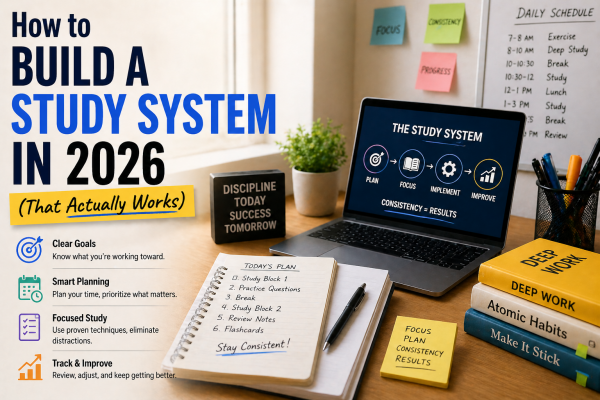
A study system fixes that. It gives you structure, makes progress easy to track, and stops you wasting time. The goal is not to study all day. The goal is to study in a way that produces results.
This blog explains how to build a study system in 2026 that is simple, realistic, and easy to maintain.
Modern learning is noisy. You have:
short attention spans because of constant scrolling
too many resources (videos, notes, apps, AI tools)
pressure to do "more” instead of doing "better”
exam content that keeps building on earlier topics
A system protects you from chaos. It makes sure you:
learn new topics properly
remember them long-term
practise in exam format
improve from mistakes
Without a system, you will keep repeating the same cycle: revise, forget, revise again, feel behind.
A common mistake is using too many apps. You do not need ten tools. You need one simple setup that you can use every day.
Choose one method:
one notebook for notes
one notebook page for weekly plan
one page for mistakes
one notes app
one flashcard or quiz tool
one calendar (or simple weekly schedule)
Keep it clean. The simpler your tools, the more likely you will use them.
A strong study system has three actions that repeat.
This is where you take in the lesson, notes, or video. But the key is what you do next.
Do not just read. You must create an output:
write a short explanation in your own words
draw a quick diagram
list steps of a method
write a 5-line summary
If you cannot explain it, you do not understand it.
This is the most important part of studying. It is how memory is built.
After learning a topic, close everything and do one of these:
write what you remember on a blank page
answer 10 questions from memory
teach the topic out loud in simple words
Then check your gaps. This is where real improvement happens.
Most students revise the same topic again and again in the same week, then forget it later. That is not revision. That is short-term cramming.
Smart review uses spacing. This means you revisit topics after time has passed.
A simple schedule:
review after 1 day
then 3 days
then 7 days
then 14 days
then weekly until exams
This is how you keep topics alive in your memory.
Motivation is unreliable. A weekly plan is reliable.
Once a week (for example Sunday), spend 20–30 minutes to plan.
Your weekly plan must include:
what topics you will cover
what topics you will review
what exam-style practice you will do
what your weak areas are
You only need a short plan. But it must exist.
A good weekly plan answers one question: If I do this plan, will I move forward?
Many students revise content but do not practise exam questions enough. Then they lose marks because they:
misunderstand command words
write too much or too little
fail to show working
struggle with timing
In 2026, exams still reward performance, not effort.
So your system must include exam practice every week.
Simple options:
one timed question per session
one past paper section per week
one full paper every two weeks (closer to exams)
This makes exams feel normal, not scary.
A mistake is not failure. A mistake is a map.
Most students ignore their mistakes. Strong students study them.
Create a "Mistake Bank” where you record:
what you got wrong
why you got it wrong
the correct method or answer
one similar question to practise
Then revisit the mistake bank twice a week.
This stops you from repeating errors and improves marks faster than re-reading notes.
You do not need to study 8 hours a day. You need quality plus consistency.
A strong daily structure is:
Each session should include:
5 minutes planning
40–50 minutes focused work
5–10 minutes recall test
Use this for:
flashcards
quick quiz
review notes
mistake bank practice
This system is sustainable, even with school, homework, and life.
AI can help studying, but only if you use it properly.
Good uses:
generating practice questions
explaining mistakes in simple words
testing you with quick quizzes
helping you write model answers (then you rewrite in your own words)
Bad uses:
copying notes without thinking
getting AI to solve everything for you
skipping recall and practice
using AI as "comfort”, not learning
Your rule should be: AI supports your learning. It does not replace your thinking.
A study system is only useful if you can follow it on tired days.
So your system must be:
simple
trackable
repeatable
flexible
If it feels heavy, you will stop.
The best system is not the most complex. It is the one you can keep doing.
Here is a clean structure you can follow right away:
Weekly
plan topics + reviews + exam practice
pick your top weak topics
schedule one past paper block
Daily
2 deep sessions (learn + recall)
1 light session (review + mistakes)
Always
end sessions with a test
track mistakes
review with spacing
If you do this consistently, your confidence improves because your progress becomes predictable.
In 2026, the students who win are not the ones who study the most. They are the ones who study with a system. A system turns effort into results. It reduces stress and increases consistency. Most importantly, it helps you remember what you learned when it matters.
If you tell me your level (GCSE, A-Level, or university) and your subjects, I can rewrite this blog to match your exact audience and make it 1,000+ words with examples for your subjects.