Boss jee, below is a ~4000-word long-form blog on your exact topic, written in a GCSE (UK) friendly way, but still strong enough for a general audience.
Osmosis in Plants: Root Hair Cells Step-by-Step (A Clear GCSE Guide)
Meta Title
Osmosis in Plants (Root Hair Cells) – Step-by-Step GCSE Biology Explanation
Meta Description
Learn osmosis in plants with a step-by-step explanation using root hair cells. Understand water potential, turgor, plasmolysis, and how water reaches the xylem (GCSE-level).
Suggested Keywords
osmosis in plants, root hair cells, water potential, partially permeable membrane, turgor pressure, xylem, mineral ions, active transport, transpiration stream, GCSE biology
Table of Contents
-
Why plants need osmosis
-
What osmosis really means (and what it doesn’t)
-
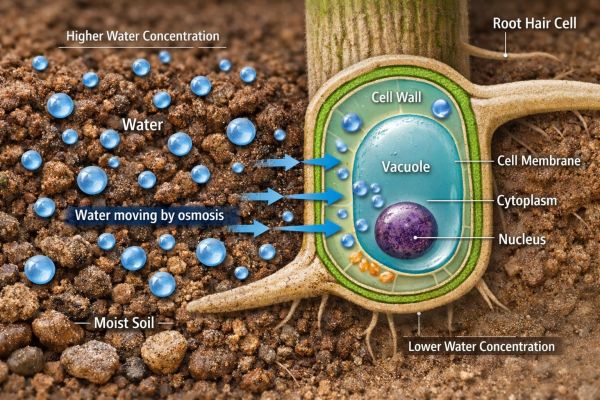
The root hair cell: structure and purpose
-
Root hair cell adaptations for osmosis
-
Osmosis step-by-step: soil → root hair cell → xylem
-
What is "water potential” (GCSE-friendly)
-
How minerals affect osmosis (active transport link)
-
How water moves across the root (apoplast vs symplast)
-
The endodermis and why it matters (Casparian strip)
-
What happens in drought or salty soil
-
Turgor, wilting, and plasmolysis explained
-
Factors affecting the rate of water uptake
-
Osmosis practicals: potato + plant-based ideas
-
Exam tips and common mistakes
-
Quick recap + glossary + practice questions
1) Why Plants Need Osmosis
Plants depend on water for three big reasons:
1) Photosynthesis
Water is a raw material needed to make glucose.
2) Transport
Water carries mineral ions from roots to leaves through the xylem.
3) Support
Water pressure inside cells keeps stems and leaves firm. This firmness is called turgor.
Unlike animals, plants can’t move to find water. They must absorb it from the soil. The main process that makes water enter the root is osmosis, and the specialised cells responsible are root hair cells.
2) What Osmosis Really Means (and What It Doesn’t)
A lot of students memorise a definition but still get confused in exam questions. So let’s make it crystal clear.
GCSE Definition
Osmosis is the net movement of water molecules through a partially permeable membrane from a region of higher water potential to a region of lower water potential.
In simpler words
Water moves from where there is more "free” water (more dilute solution) to where there is less "free” water (more concentrated solution), across a membrane.
What osmosis is NOT
-
Osmosis is not the movement of salt, sugar, or minerals (that’s different processes).
-
Osmosis is not "water moving anywhere it wants”—it must pass through a partially permeable membrane.
-
Osmosis is passive (does not require energy).
3) The Root Hair Cell: Structure and Purpose
A root hair cell is a specialised epidermal cell on young roots. It grows a long, thin extension (a "hair”) that pushes between soil particles.
Its main job
To absorb:
Root hair cells are found just behind the root tip, where cells are mature enough to form hairs and the root is actively taking up water.
4) Root Hair Cell Adaptations for Osmosis
Root hair cells are built like high-efficiency water absorbers. These adaptations are common GCSE marks.
1) Very large surface area
The "hair” extension massively increases surface area, increasing the rate of water absorption.
2) Thin cell wall
A thin wall gives a short path for water to travel into the cell.
3) Large vacuole with concentrated cell sap
The vacuole contains cell sap (a solution of dissolved substances). This helps keep the cell’s inside more concentrated than the soil water, encouraging water to enter.
4) Partially permeable cell membrane
Controls what enters and exits the cell, allowing water molecules through but limiting larger molecules.
5) Many mitochondria (indirectly helps osmosis)
Mineral ions are taken in using active transport, which needs ATP from mitochondria. Mineral uptake can make the cell sap more concentrated, which can help draw in water by osmosis.
6) Usually no chloroplasts
Root hair cells are underground, so they don’t receive enough light for photosynthesis.
5) Osmosis Step-by-Step: Soil → Root Hair Cell → Xylem
This is the core of your topic. Here is the full step-by-step flow, explained in a clean and exam-ready way.
Step 1: Soil water exists as a "soil solution”
Water surrounds soil particles as a thin film. This water contains dissolved minerals (like nitrates and magnesium). We call this mixture the soil solution.
Usually:
Step 2: The root hair cell has concentrated cell sap
Inside the root hair cell (especially in the vacuole) the cell sap is often more concentrated than the soil solution.
So:
Step 3: Water moves into the root hair cell by osmosis
Because water moves from higher water potential → lower water potential, water enters the root hair cell through its partially permeable membrane.
✅ GCSE sentence (use this in answers):
"Water enters the root hair cell by osmosis down a water potential gradient from the soil solution into the cell sap.”
Step 4: The vacuole fills, and the cell becomes turgid
As water enters, the vacuole expands. The cell membrane pushes against the cell wall. This creates turgor pressure.
A turgid cell is firm and supports the plant.
Step 5: Water moves from the root hair cell to other root cells
Water does not stay in the root hair cell. It moves from cell to cell across the root.
This movement happens because:
This movement is still linked to osmosis, but it can involve different routes (explained later).
Step 6: Water reaches the xylem
Eventually water arrives at the xylem vessels in the centre of the root.
Once inside the xylem:
So the key big picture is:
Soil solution → root hair cell → cortex cells → (endodermis) → xylem → stem → leaves
6) What Is "Water Potential” (GCSE-Friendly)
Water potential can sound scary, but it’s simple if you treat it as "how much water wants to move.”
Basic meaning
Water potential is a measure of the tendency of water to move.
-
Pure water has the highest water potential
-
Adding solutes (salt/sugar/minerals) makes water potential lower
-
Water moves from higher water potential to lower water potential
How it links to concentration
That’s why water enters the root hair cell if the soil is more dilute than the cell sap.
7) How Minerals Affect Osmosis (Active Transport Link)
This part makes your blog stronger because many articles forget it.
Mineral ions (like nitrate ions) often have a lower concentration in soil than inside the root.
So plants take minerals in using active transport:
Why this matters for osmosis
When mineral ions enter:
-
the root hair cell sap becomes more concentrated
-
water potential inside becomes lower
-
water is more likely to enter by osmosis
So, mineral uptake can indirectly "pull” water in by lowering water potential inside the root hair cell.
8) How Water Moves Across the Root (Apoplast vs Symplast)
This section is excellent for higher-quality content and helps with tougher GCSE / early A-level understanding.
Once water enters the root hair cell, it moves towards the xylem via two main pathways:
1) Apoplast pathway
Water travels through:
-
cell walls
-
spaces between cells
This is fast because it doesn’t cross many membranes.
2) Symplast pathway
Water travels through:
This route involves crossing the cell membrane at least once, so it can be more controlled.
In reality, water often uses a mix of both.
9) The Endodermis and Casparian Strip (Why It Matters)
The endodermis is a layer of cells around the central vascular bundle (where the xylem is).
A waterproof band called the Casparian strip blocks the apoplast route.
Why plants do this
The Casparian strip forces water and dissolved substances to pass through cell membranes at the endodermis. This allows the plant to:
Even if your audience is GCSE, adding a short, clear explanation like this makes your blog look more expert and trustworthy.
10) What Happens in Drought or Salty Soil?
Osmosis depends on water potential. If the soil becomes too concentrated (dry or salty), the direction of water movement can change.
Drought (very dry soil)
-
less water in soil solution
-
soil becomes effectively "more concentrated”
-
water potential outside becomes lower
-
water enters more slowly or may stop
Salty soil / too much fertiliser
-
lots of dissolved salts
-
soil water potential becomes very low
-
water can move out of root cells into soil
-
plant may wilt even if soil looks "wet” (because it’s salty)
This is why over-fertilising can damage plants: it can cause water to leave the roots by osmosis.
11) Turgor, Wilting, and Plasmolysis Explained
Turgor (healthy, firm plant)
When water enters plant cells, they become turgid.
Wilting (loss of support)
If water leaves cells:
Plasmolysis (extreme water loss)
If a plant cell is placed in a very concentrated solution:
Plasmolysis is serious and can damage the plant if prolonged.
12) Factors Affecting the Rate of Water Uptake
Water absorption by root hair cells is not the same all the time. These factors affect it:
1) Water potential gradient
Bigger difference between soil and cell sap = faster osmosis.
2) Temperature
Higher temperature increases movement of particles, so osmosis can be faster (up to a point).
3) Surface area of roots/root hairs
More root hairs = faster absorption.
4) Oxygen availability for respiration
Active transport needs ATP, and ATP production needs respiration. If soil is waterlogged and low in oxygen, mineral uptake reduces, which can affect water uptake too.
5) Transpiration rate
When leaves lose water via transpiration, xylem water potential becomes lower, helping pull water up and encouraging more uptake from roots.
13) Osmosis Practicals (Potato + Plant-Based Ideas)
Classic GCSE osmosis practical: potato cylinders
Students place potato pieces in different sugar/salt concentrations and measure mass change.
What it shows:
Even though potato tissue isn’t a root hair cell, it demonstrates the exact osmosis principle used in roots.
Plant-based extension idea (blog-friendly)
You can describe a simple demo:
-
place a small plant cutting in pure water vs salty water
-
observe firmness (turgor) over time
-
relate changes to osmosis and water potential
If you want, I can write a full "method + results table template + conclusion” section for your blog or classroom worksheet.
14) Exam Tips and Common Mistakes
If your blog audience is GCSE students, this section is gold.
Key phrases examiners like
-
"partially permeable membrane”
-
"water potential gradient”
-
"from higher water potential to lower water potential”
-
"root hair cell increases surface area”
-
"cell sap is more concentrated than soil solution”
-
"mineral ions enter by active transport using ATP”
Common mistakes
-
Saying osmosis moves minerals (it doesn’t—osmosis is water only)
-
Forgetting the membrane
-
Mixing diffusion and osmosis
-
Not mentioning water potential when asked "why does water move?”
-
Writing "water moves from high concentration to low concentration” (not ideal wording for osmosis)
Better wording:
15) Quick Recap (One-Minute Summary)
-
Root hair cells absorb water mainly by osmosis
-
Soil water usually has higher water potential than cell sap
-
Water moves into the root hair cell through a partially permeable membrane
-
Water then passes across the root into the xylem
-
Active transport of minerals can lower water potential inside roots, helping water enter
-
Drought or salty soil can reduce water uptake or even reverse it
Mini Glossary (Fast Revision)
Osmosis: movement of water across a partially permeable membrane from higher to lower water potential
Water potential: measure of tendency for water to move; solutes lower it
Turgid: firm cell due to water pressure
Flaccid: limp cell due to water loss
Plasmolysis: membrane pulls away from cell wall after extreme water loss
Xylem: vessels that transport water and minerals
Active transport: movement against concentration gradient using ATP
Practice Questions (GCSE-Style)
-
Define osmosis. (2 marks)
-
Explain two adaptations of root hair cells for absorption. (4 marks)
-
The soil becomes very salty. Predict what happens to the root hair cells and explain why. (4 marks)
-
Describe the pathway of water from soil into the xylem. (4–6 marks)
-
Explain how active transport of mineral ions can affect water uptake. (3–4 marks)