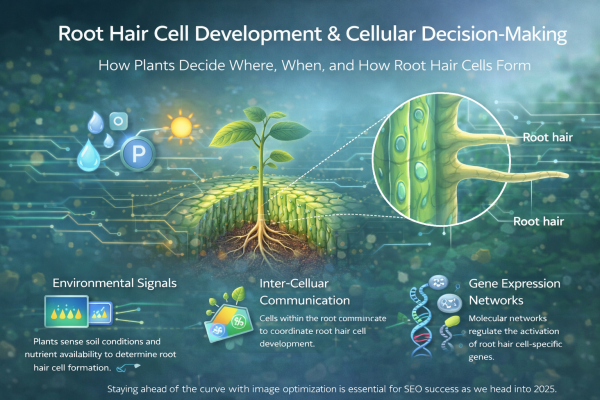
Root hair cells are often introduced in biology as simple extensions of root epidermal cells designed to increase surface area for water and mineral uptake. While this description is not incorrect, it is deeply incomplete. In reality, the root hair cell represents one of the most sophisticated examples of cellular decision-making in plants.
A plant does not randomly produce root hair cells, nor does every epidermal cell become one. Instead, plants actively regulate which cells form root hairs, where they form, when they initiate growth, how long they extend, and when growth stops. These decisions are controlled through a complex interaction of genetics, positional signals, hormones, and environmental feedback.
Understanding root hair cells from this developmental and regulatory perspective transforms them from a memorized exam topic into a powerful model of plant intelligence and adaptability.
In early biology education, root hair cells are usually presented as a fixed cell type. This creates the false impression that root hair formation is automatic. In reality, root hair identity is a chosen developmental fate, not a default condition.
Every epidermal cell in a young root begins with the potential to follow more than one developmental pathway. Through internal genetic programs and external positional cues, each cell adopts a specific identity. Some cells become root hair-forming cells, while others become non-hair epidermal cells.
This selective process ensures structural stability, metabolic efficiency, and optimal resource allocation within the root system.
Root epidermal cells differentiate into two functionally distinct populations:
Cells that will form root hairs
Cells that will remain hairless
This differentiation occurs early, shortly after cell division. Importantly, this decision is predictable and patterned, not random. The regular spacing of root hairs along the root surface reflects precise biological control.
If all epidermal cells formed root hairs, the root surface would become overcrowded, mechanically unstable, and energetically inefficient. Controlled differentiation allows plants to maximize absorption while maintaining structural integrity.
One of the most elegant aspects of root hair development is the role of positional information. Epidermal cells determine their fate based on their physical position relative to underlying cortical cells.
An epidermal cell located above the junction between two cortical cells receives signals that promote root hair formation. In contrast, an epidermal cell located directly above a single cortical cell receives signals that suppress hair formation.
This system demonstrates that plant cells:
Sense spatial relationships
Interpret positional cues
Modify gene expression accordingly
This spatial awareness challenges the outdated idea that plant cells operate passively.
Root hair development is controlled by tightly regulated genetic networks. Rather than a single "root hair gene,” multiple regulatory genes interact to define cell identity.
Some genes promote hair formation, while others suppress it. The balance between these opposing signals determines the final outcome. Crucially, these genes regulate identity, not just structure. A cell must first "decide” what it is before it can build the appropriate cellular machinery.
This layered genetic control allows flexibility, enabling plants to adapt root hair patterns in response to environmental conditions.
Plant hormones play a central role in refining root hair development. Among the most influential are auxin and ethylene.
Auxin influences both the initiation and elongation of root hairs. Changes in auxin distribution within the root epidermis can rapidly alter root hair density and length. When nutrients are scarce, auxin signaling often promotes increased root hair formation to improve uptake efficiency.
Ethylene interacts with auxin signaling, particularly under stress conditions. It modulates growth rates and helps coordinate root hair development with broader root system responses.
Together, these hormones ensure that root hair formation is dynamic rather than fixed.
Root hair growth does not emerge from the entire cell surface. Instead, the cell selects a precise initiation site on its outer wall. This localized decision is critical.
At the initiation site:
The cell wall becomes locally modified
Cytoskeletal elements reorganize
Vesicles deliver new membrane and wall materials
This targeted approach ensures directional growth and prevents structural failure.
Root hair cells grow using a mechanism known as tip growth, where expansion occurs exclusively at the cell apex. The remainder of the cell remains structurally stable.
Tip growth allows root hairs to:
Penetrate narrow soil spaces
Navigate around obstacles
Maintain mechanical strength during elongation
This growth strategy is highly efficient and is also observed in pollen tubes and fungal hyphae, highlighting its evolutionary importance.
A defining feature of tip growth is the presence of a calcium ion gradient at the growing tip. Calcium ions act as signaling molecules that regulate vesicle fusion, cytoskeletal dynamics, and growth direction.
Disruption of calcium signaling leads to abnormal root hair morphology, such as twisting or branching, which reduces absorption efficiency. This demonstrates that root hair growth is not merely mechanical but also electrochemical in nature.
Root hair cells are uniquely positioned to act as environmental sensors. Their direct contact with soil allows them to detect changes in:
Water availability
Nutrient concentration
Soil pH
Toxic substances
In response, root hair cells adjust growth patterns and metabolic activity. This sensory role allows plants to respond rapidly to fluctuating soil conditions.
Phenotypic plasticity refers to the ability of a single genotype to produce different physical traits under different environmental conditions. Root hair cells exemplify this principle.
In nutrient-poor soils, plants often develop longer and denser root hairs. In nutrient-rich soils, root hair development may be reduced. This flexibility enhances survival across diverse environments without requiring genetic change.
Producing root hairs requires energy. Cell wall synthesis, membrane expansion, ion transport, and signaling all consume ATP.
Plants therefore balance the benefits of increased absorption against the energetic cost of producing and maintaining root hairs. This cost-benefit analysis explains why root hair density is tightly regulated rather than maximized.
Soil is a competitive ecosystem. Multiple plants and microorganisms compete for limited nutrients. Root hair cells provide plants with a competitive advantage by increasing access to microscale nutrient pools that would otherwise remain unavailable.
This competitive function highlights the ecological importance of root hair development beyond individual plant survival.
Modern agriculture increasingly focuses on root traits rather than above-ground features alone. Crops with efficient root hair systems often:
Require less fertilizer
Exhibit improved drought tolerance
Reduce environmental nutrient runoff
Understanding root hair development supports the design of sustainable agricultural systems.
Advances in plant biology are enabling researchers to modify root hair development pathways. The goal is to produce crops that maintain high yields under low-input conditions.
By enhancing root hair efficiency rather than simply increasing fertilizer use, agriculture can become more environmentally responsible and economically viable.
Teaching root hair cells as static structures encourages memorization rather than understanding. A developmental and regulatory perspective allows students to:
Connect genetics with physiology
Apply concepts logically in exams
Build a foundation for advanced plant biology
This approach transforms root hair cells from a small syllabus topic into a central concept.
Root hair cells are not passive extensions of roots. They are the result of complex decision-making processes involving genetics, positional information, hormonal signaling, and environmental sensing.
Understanding root hair cells in this way reveals the hidden intelligence of plants and reinforces the idea that plant biology is dynamic, responsive, and deeply integrated.
Root hair cells do more than absorb water and minerals — they help determine how plants survive, compete, and adapt in a changing world.
While root hair development appears simple at the surface, internally it requires extraordinary molecular coordination. At any moment during growth, thousands of proteins operate in synchrony. Structural proteins maintain shape, transport proteins move ions, enzymes regulate metabolism, and signaling molecules ensure accurate timing.
One of the most remarkable features of the root hair cell is that growth and absorption occur simultaneously. While the cell tip extends outward, ion channels and transporters embedded in the membrane continue functioning efficiently. This dual functionality reflects a highly optimized internal organization rarely appreciated at school level.
The cytoskeleton, composed primarily of actin filaments, plays a decisive role in root hair development. These filaments form dynamic tracks along which vesicles move toward the growing tip.
Unlike rigid scaffolding, the cytoskeleton is continuously remodeled. Filaments assemble, disassemble, and reposition in response to signaling cues. This flexibility allows the cell to:
Change growth direction
Adjust growth speed
Respond to physical obstacles in the soil
Without this internal framework, tip growth would collapse into uncontrolled expansion.
Root hair elongation requires a constant supply of new membrane and cell wall material. This material is transported in vesicles originating from internal compartments.
At the tip:
Vesicles fuse with the plasma membrane
New membrane expands the cell surface
Cell wall components are deposited externally
This process occurs continuously during growth, demonstrating that the root hair cell is engaged in real-time construction, not post-growth reinforcement.
Root hair cells are widely known for mineral ion uptake, but fewer people realize that ion transport also plays a regulatory role. Ion gradients influence membrane potential, signaling pathways, and growth direction.
For example:
Proton gradients affect nutrient availability
Potassium fluxes influence cell turgor
Calcium gradients guide growth orientation
Thus, ion transport serves both nutritional and informational purposes.
Root hair cells do not operate in isolation. They communicate with neighboring epidermal cells, cortical cells, and vascular tissues.
This communication ensures that:
Absorbed ions are efficiently transported inward
Water movement remains coordinated
Growth remains synchronized with overall root development
Such integration highlights the cooperative nature of plant tissues.
Soil is rich in microorganisms, many of which interact directly with root hair cells. Some bacteria and fungi form beneficial associations, enhancing nutrient uptake. Others pose threats that must be detected and managed.
Root hair cells participate in these interactions by:
Releasing chemical signals
Altering growth patterns
Activating defense-related pathways
These interactions place root hair cells at the interface between plant physiology and soil ecology.
In extreme environments where nutrients are scarce, root hair cells become even more critical. Plants growing in such conditions often show dramatic increases in root hair length and density.
This response is not accidental. It reflects a strategic reallocation of resources toward root surface expansion, allowing plants to exploit even minimal nutrient availability.
Under drought conditions, water availability becomes unpredictable. Root hair cells adapt by modifying growth behavior. Some plants produce fewer but thicker root hairs, reducing water loss while maintaining absorption efficiency.
This adaptive response demonstrates that root hair development is context-dependent, shaped by multiple environmental pressures rather than a single factor.
From an evolutionary standpoint, root hair cells provided early land plants with a crucial advantage. By increasing contact with soil, they enabled efficient nutrient and water uptake in terrestrial environments.
This adaptation likely contributed significantly to the success of plants on land, shaping ecosystems and ultimately supporting animal life.
Although leaves and fruits are the visible indicators of crop performance, roots quietly determine yield potential. Crops with efficient root hair systems often outperform others under identical conditions.
This realization has shifted research focus from above-ground traits to root architecture, including root hair development.
Different plant species—and even different varieties within a species—show variation in root hair traits. Length, density, lifespan, and responsiveness to nutrients all vary.
This diversity provides a valuable resource for plant breeding. By selecting varieties with advantageous root hair characteristics, breeders can improve performance without genetic modification.
Sustainable agriculture aims to reduce dependence on chemical inputs. Root hair biology plays a central role in this goal.
Efficient root hair systems:
Reduce fertilizer requirements
Minimize nutrient runoff
Improve soil health
By enhancing natural absorption mechanisms, agriculture becomes both productive and environmentally responsible.
Climate change introduces unpredictable stress factors such as drought, flooding, and soil degradation. Root hair cells contribute to plant resilience by enabling flexible responses to changing conditions.
Plants capable of adjusting root hair development rapidly are better equipped to survive environmental instability.
Root hair cells offer an ideal model for teaching systems biology. They demonstrate how structure, function, genetics, environment, and energy interact within a living system.
This makes them valuable not only for biology education but also for fostering analytical thinking.
Students who understand root hair development at a conceptual level can answer exam questions more effectively. Instead of listing adaptations, they can explain why those adaptations exist.
This depth of understanding aligns with higher mark schemes and advanced assessment criteria.
Many misconceptions persist about root hair cells, including:
That all epidermal cells form root hairs
That growth is uniform across the cell
That absorption is purely passive
Correcting these misconceptions improves both academic accuracy and conceptual clarity.
Root hair cells exemplify how cells integrate multiple signals to make coherent decisions. They show that even non-animal cells can exhibit sophisticated regulatory behavior.
This challenges simplistic distinctions between plant and animal intelligence.
Ongoing research continues to uncover new layers of complexity in root hair development. Scientists are exploring:
Signal integration mechanisms
Stress-responsive growth pathways
Long-term adaptation strategies
These discoveries will further refine our understanding of plant biology.
Despite their importance, root hair cells receive limited attention in mainstream discussions. Expanding focus on this topic enriches both education and research.
They serve as a gateway to understanding broader biological principles.
Root hair cells are far more than microscopic structures on plant roots. They are dynamic, responsive, and intelligently regulated systems that play a decisive role in plant survival.
By integrating genetic instructions, positional information, hormonal signals, and environmental feedback, root hair cells embody the essence of living systems.
Understanding them fully means moving beyond memorization and embracing biology as a science of interaction, adaptation, and decision-making.
One of the most impressive aspects of root hair cell development is how the cell integrates multiple signals without confusion. At any moment, the cell may receive genetic instructions, hormonal signals, positional cues, and environmental feedback simultaneously.
Instead of responding to each signal independently, the root hair cell prioritizes and integrates them into a single coordinated response. For example, if positional cues favor root hair formation but environmental conditions are unfavorable, growth may be delayed or modified rather than fully initiated.
This integration prevents wasted energy and structural instability, ensuring that development aligns with real-world conditions.
Equally important to initiating root hair growth is knowing when to stop. Unlimited growth would be inefficient and potentially harmful.
Growth termination occurs when:
The root hair reaches optimal length
Nutrient uptake becomes sufficient
Environmental conditions stabilize
At this stage, signaling pathways reduce vesicle delivery and cytoskeletal activity at the tip. The cell transitions from a growth phase to a maintenance phase, focusing on absorption rather than expansion.
Root hair cells are not permanent structures. They have a defined lifespan that corresponds to the functional needs of the plant.
As the root elongates and moves through soil, older root hair cells may lose contact with nutrient-rich zones. These cells gradually degenerate and are replaced by newly formed root hairs closer to the root tip.
This turnover ensures that absorption remains efficient without requiring constant expansion of the entire root surface.
Root hair development influences how resources are distributed throughout the plant. Increased absorption at the root level affects:
Leaf growth
Stem elongation
Flower and seed production
Thus, root hair cells indirectly shape the plant’s overall architecture and reproductive success. This connection reinforces the idea that roots are not subordinate structures but central regulators of plant performance.
From an educational perspective, root hair cells offer a perfect introduction to systems biology. They illustrate how:
Genes influence structure
Structure enables function
Function feeds back into regulation
Environment shapes outcomes
Few biological topics demonstrate these connections as clearly within a single cell type.
While the fundamental principles of root hair development are conserved, species-specific differences exist. Some plants rely heavily on dense root hair systems, while others depend more on root branching or symbiotic relationships.
This diversity reflects evolutionary adaptation to different ecological niches and soil conditions.
In many plants, root hair cells play a role in initiating symbiotic relationships with beneficial microorganisms. These partnerships enhance nutrient uptake and stress tolerance.
Root hair cells often act as the first point of contact, releasing chemical signals that attract symbiotic partners. This function places them at the center of complex biological networks extending beyond the plant itself.
As agriculture moves toward sustainability, low-input farming systems are gaining importance. In such systems, plants must rely more on natural absorption mechanisms.
Root hair efficiency becomes a key determinant of success, allowing crops to thrive with minimal external inputs.
Healthy soil supports effective root hair development, and effective root hair development, in turn, improves soil structure. Root hairs help bind soil particles, enhance microbial activity, and promote stable soil aggregates.
This reciprocal relationship highlights the role of root hair cells in ecosystem stability.
Improving root hair traits offers an ethical alternative to excessive chemical use. Instead of forcing productivity through external inputs, agriculture can align with natural biological processes.
This approach supports food security while minimizing environmental harm.
They are genetically regulated but not rigidly predetermined. Environmental signals can modify gene expression and alter outcomes.
No. They absorb mineral ions, participate in signaling, interact with microbes, and contribute to soil structure.
Survival is severely compromised. Root hair cells dramatically enhance absorption efficiency, especially in nutrient-poor soils.
They are continuously produced near the root tip and replaced as older ones degenerate.
Treating root hair cells as static structures
Ignoring positional control
Confusing absorption with diffusion only
Overlooking hormonal and genetic regulation
Avoiding these mistakes significantly improves analytical answers.
Including root hair cell development from a decision-making perspective immediately elevates a blog or academic article. It demonstrates:
Conceptual depth
Interdisciplinary understanding
Awareness of modern biological thinking
This makes the content suitable for advanced students, educators, and researchers alike.
Root hair cells teach a powerful lesson: even the smallest biological structures operate through intelligent coordination. Growth, adaptation, and survival are not accidental outcomes but the result of continuous decision-making at the cellular level.
This insight reshapes how we understand plants—and life itself.
Root hair cells are far more than microscopic extensions of plant roots. They are dynamic, responsive, and strategically regulated units that play a decisive role in plant survival, productivity, and adaptation.
By integrating genetic programs, positional information, hormonal signals, and environmental feedback, root hair cells exemplify the core principles of living systems.
Understanding them fully moves biology beyond memorization and into the realm of reasoning, systems thinking, and real-world relevance.