When students first learn about plants in biology, attention often goes to leaves, stems, flowers, and fruits. These parts are visible, familiar, and easy to observe. However, some of the most important biological processes happen underground, hidden from view. Among the most important structures responsible for plant survival are root hair cells.
Root hair cells may be microscopic, but their role in plant health is enormous. Without them, plants would struggle to absorb enough water and minerals to survive, grow, and reproduce. These tiny extensions of root cells form the critical link between soil and plant, ensuring that essential resources move efficiently from the environment into living tissue.
In this blog, we explore the secrets of root hair cells, examining their structure, function, adaptations, and importance for plant health. The discussion is fully aligned with GCSE Biology, and explains not just what root hair cells do, but why they are so vital.
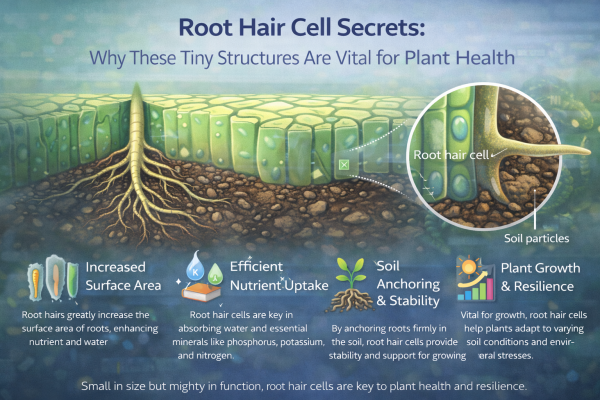
A root hair cell is a specialised plant cell found on the surface of plant roots. It is an extension of a root epidermal cell and is specifically adapted to absorb water and mineral ions from the soil.
Unlike many plant cells, root hair cells are not designed for protection or support. Their single purpose is absorption. This specialisation allows plants to take in the resources they need even when water or minerals are scarce.
Root hair cells are short-lived, constantly replaced as roots grow and push through soil. This ensures that the plant always has an active absorption surface in contact with fresh soil.
Plants cannot move to search for food or water. Instead, they rely entirely on their root system to supply everything they need. Root hair cells make this possible.
Without root hair cells:
water uptake would be slow and inefficient
mineral ion absorption would be severely limited
growth would be restricted
leaves would wilt and photosynthesis would reduce
In extreme cases, plants would die even if water was present in the soil, simply because they could not absorb it efficiently.
Understanding the structure of a root hair cell helps explain how it performs its function so effectively.
A root hair cell has:
a long, thin hair-like extension
a large surface area
a thin cell wall
a partially permeable cell membrane
a large vacuole
many mitochondria
Each of these features plays a specific role in absorption.
The most obvious feature of a root hair cell is its long extension. This extension dramatically increases the surface area of the root.
A greater surface area allows:
more water to enter by osmosis
more mineral ions to enter by diffusion and active transport
This adaptation is critical, especially in dry or nutrient-poor soil.
The cell wall of a root hair cell is extremely thin. This reduces the distance water and ions must travel to enter the cell, increasing the rate of absorption.
Thick walls would slow diffusion and reduce efficiency.
The large vacuole contains cell sap with a low water potential. This helps draw water into the cell by osmosis from the surrounding soil, where the water potential is higher.
Root hair cells contain a high number of mitochondria. This is because active transport requires energy.
Mineral ions such as:
nitrate
magnesium
potassium
often move into the root hair cell against a concentration gradient, which requires ATP produced by mitochondria.
Water enters root hair cells mainly by osmosis.
Osmosis is the movement of water molecules from an area of higher water potential to an area of lower water potential through a partially permeable membrane.
In soil:
water potential is relatively high
Inside the root hair cell:
water potential is lower due to dissolved substances
As a result, water moves into the cell.
Root hair cells are perfectly adapted for osmosis because:
they have a large surface area
their membranes are partially permeable
their vacuole maintains low water potential
This allows water to enter continuously as long as soil water is available.
Water is not the only substance plants need. Mineral ions are essential for growth, development, and metabolism.
Root hair cells absorb:
nitrate ions (for protein synthesis)
magnesium ions (for chlorophyll production)
potassium ions (for enzyme activity)
These ions are often present in soil at low concentrations.
Many mineral ions are absorbed by active transport. This process:
moves ions against their concentration gradient
requires energy
uses carrier proteins in the cell membrane
The high number of mitochondria in root hair cells ensures a constant supply of energy for this process.
Healthy root hair cells lead to healthy plants. Their efficiency affects every aspect of plant life.
If mineral absorption is reduced:
protein synthesis slows
chlorophyll production decreases
photosynthesis becomes less efficient
This results in stunted growth and pale leaves.
Without sufficient water absorption:
cells lose turgor
leaves wilt
stomata close
carbon dioxide uptake decreases
This directly reduces photosynthesis and energy production.
Plants grow in a wide range of environments. Root hair cells show remarkable adaptability.
Plants may:
produce longer root hairs
increase the number of root hair cells
This increases the chance of contacting water particles.
Root hair cells:
increase active transport activity
absorb ions more efficiently
may form associations with fungi (mycorrhizae)
These strategies improve mineral uptake.
In many plants, root hair cells work alongside mycorrhizal fungi. These fungi:
extend into the soil
increase surface area even further
help absorb water and minerals
In return, the plant supplies sugars produced by photosynthesis.
This relationship greatly improves plant health and survival.
Root hair cells are not just important in natural ecosystems. They are vital in farming and food production.
Healthy root hair cells:
improve crop yield
increase resistance to drought
reduce need for fertilisers
Understanding root hair cell function helps farmers manage soil conditions more effectively.
Students often:
confuse root hair cells with root tips
forget active transport requires energy
fail to link structure to function
describe diffusion instead of osmosis
Clear understanding avoids these errors.
High-mark answers:
describe structure clearly
link adaptations to function
use correct terminology
explain processes step by step
Examiners reward explanation, not memorisation.
At this stage, you should understand that:
root hair cells are specialised for absorption
their structure increases efficiency
they absorb water by osmosis
they absorb minerals by active transport
they are essential for plant health
To truly understand why root hair cells are so important, it helps to compare them with other cells found in the root. Not all root cells are designed for absorption. Each type has a different role, and root hair cells are uniquely specialised.
Cells in the root cortex are mainly involved in storage, while cells in the xylem are responsible for transporting water upwards through the plant. Cells in the phloem move sugars around the plant. Root hair cells, however, are positioned at the outermost layer of the root, in direct contact with soil particles.
This position is crucial. Water and mineral ions must first pass through root hair cells before moving deeper into the plant. If absorption is inefficient at this stage, the entire transport system is affected.
Root hair cells are therefore the gateway between soil and plant life.
Root hair cells are located just behind the root tip, not at the very end of the root. This positioning is deliberate and biologically important.
The root tip is protected by a root cap and is responsible for growth and penetration of the soil. Cells here are not specialised for absorption. Just behind this region, cells differentiate into root hair cells.
This ensures that:
root hair cells are not damaged as the root pushes through soil
absorption occurs in stable regions of the root
fresh root hair cells are constantly produced as the root grows
This constant renewal maintains high absorption efficiency.
Once water enters a root hair cell, its journey through the plant is carefully controlled.
Water moves:
from the root hair cell into neighbouring root cortex cells
through the cortex towards the xylem
into xylem vessels
upwards to the leaves
This movement relies on differences in water potential and creates a continuous flow known as the transpiration stream.
If root hair cells fail to absorb enough water at the start of this process, the entire system slows down.
Root hair cells absorb several mineral ions essential for plant health. Each ion has a specific role.
Nitrate ions are used to make amino acids and proteins. Without them:
growth slows
leaves may turn yellow
protein production is reduced
Magnesium is needed to make chlorophyll. A lack of magnesium causes:
yellowing between leaf veins
reduced photosynthesis
weaker plants
Potassium supports enzyme function and stomatal control. Deficiency can lead to:
poor water regulation
reduced photosynthesis
weak resistance to stress
Root hair cells must absorb these ions efficiently to maintain healthy growth.
In agriculture, fertilisers are often added to soil to increase mineral availability. However, fertilisers must be used carefully.
When used correctly, fertilisers:
increase mineral ion concentration in soil
reduce energy needed for active transport
support faster growth
Excess fertiliser can:
reduce water potential in soil
cause water to leave root hair cells
damage cell membranes
kill root hair cells
This process, known as plasmolysis, can severely harm plant health.
In very dry soil, the water potential outside the root hair cell may be lower than inside. This causes water to move out of the cell.
As a result:
cells lose turgor
plants wilt
growth slows
Root hair cells are therefore extremely sensitive to environmental conditions. Their health reflects soil quality directly.
Different plants show different strategies to support their root hair cells.
deeper root systems
increased root hair length
slower growth rates
shorter root hairs
adaptations to waterlogged soil
specialised air spaces
These adaptations ensure root hair cells function efficiently in different environments.
Root hair cells are a favourite topic in GCSE Biology exams because they allow examiners to test:
structure and function
osmosis and active transport
adaptation
application of knowledge
"Explain how root hair cells are adapted for absorption”
"Describe how water enters a root hair cell”
"Explain the importance of mineral ions”
High-mark answers must link structure directly to function.
A strong answer should:
name specific adaptations
explain how each adaptation improves absorption
use correct terminology
avoid vague statements
For example, instead of saying "root hair cells are good at absorbing water”, explain why they are good at it.
Students often:
confuse diffusion with osmosis
forget that active transport requires energy
ignore the role of mitochondria
fail to mention surface area
Avoiding these mistakes significantly improves marks.
Understanding root hair cells is not just about passing exams. It helps explain:
crop production
food security
soil conservation
plant survival in changing climates
As climate change increases drought risk, efficient root hair cell function becomes even more important.
Modern agriculture focuses on sustainability. Healthy root hair cells:
reduce fertiliser use
improve water efficiency
support long-term soil health
Studying these cells helps scientists develop better farming techniques.
Root hair cells support:
plant growth
food chains
oxygen production
carbon cycling
Without efficient plant absorption, entire ecosystems would collapse.
Root hair cells may be tiny, but their importance cannot be overstated. They:
absorb water by osmosis
absorb mineral ions by active transport
support growth, photosynthesis, and survival
maintain plant health in challenging environments
Their structure is perfectly adapted to their function, making them one of the most elegant examples of specialisation in biology.
Root hair cells are a perfect reminder that size does not determine importance. These microscopic structures quietly support life on Earth by allowing plants to grow, thrive, and sustain ecosystems.
Understanding root hair cells helps students appreciate how structure and function are linked, how plants interact with their environment, and why biology matters beyond textbooks.
For GCSE Biology students, mastering this topic builds confidence, improves exam performance, and deepens understanding of living systems.
At Read With Us, we help students understand biology clearly and confidently. Our personalised lessons break down complex topics like root hair cells into simple, exam-ready explanations that build both knowledge and confidence.
Visit ReadWithUs.org.uk to explore expert-led GCSE Biology support and help your child succeed.