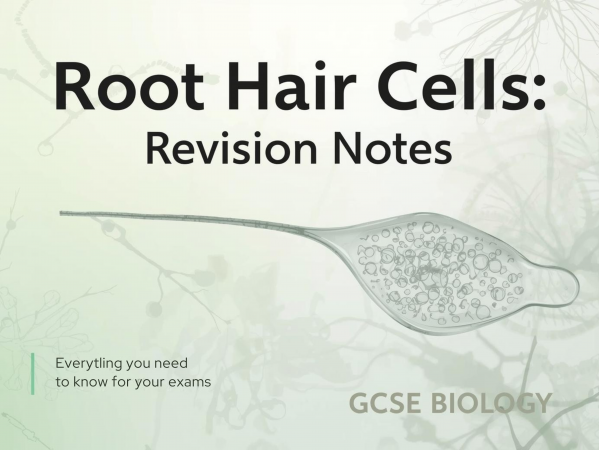
Root hair cells are some of the most important specialised cells in plants, and understanding them clearly is essential for success in GCSE Biology and similar exams. These cells help the plant absorb water and mineral ions from the soil, supporting almost every process within the plant. Because they deal directly with osmosis, diffusion, active transport, mineral uptake and water movement to the xylem, root hair cells are one of the most common exam topics. In this complete set of revision notes, you will find an extended, detailed and easy to understand explanation of how root hair cells work, why they are important, and how to write top scoring exam answers.
Root hair cells develop from epidermal cells found on the surface of young roots. These cells grow long, thin hair like extensions that reach into the soil. The design of these cells is not accidental. Every structure and feature has a purpose that improves absorption efficiency. Because plants cannot move to find water or nutrients, they depend on these tiny but powerful cells to gather what they need from the soil around them. This expanded study guide will help you fully understand their structure, their function and their importance in plant survival.
Root hair cells are specialised plant cells located in the region of differentiation on the root. They rarely live longer than two to three weeks, but during that time, they perform one of the most essential jobs in plant biology. Without these cells, the plant would not be able to collect enough water for photosynthesis or enough minerals for growth.
Root hair cells grow on the surface of young roots.
They form long hair like projections that increase surface area.
They absorb water by osmosis.
They absorb minerals by active transport.
They support xylem water transport.
They help plants stay firm by maintaining turgor pressure.
For exam purposes, you must always link structure to function. This means whenever you describe a feature of the cell, you should explain how that feature helps the cell do its job.
Understanding the structure of the root hair cell is the foundation for writing strong exam answers. Each part has a specific role.
This is the most recognisable part of the root hair cell.
It increases the surface area of the root.
Greater surface area allows more water to enter at once.
Greater surface area also allows more mineral ions to enter.
It lets the cell reach between soil particles where water collects.
Without this long extension, the plant would absorb far less water.
The cell wall of a root hair cell is thin and permeable.
Water can pass through easily.
A thin wall speeds up osmosis.
It reduces resistance to water entry.
It prevents the cell from losing contact with soil particles.
Exam tip: Always connect thin walls with faster osmosis.
The vacuole fills most of the cell and contains cell sap.
It maintains a low water concentration inside the cell.
This keeps osmosis going because water moves from high to low concentration.
It creates turgor pressure which keeps the cell firm.
It helps the root stay in close contact with soil particles.
It stores some minerals until they can move to the xylem.
The vacuole is one of the most important exam features to mention.
Root hair cells contain a high number of mitochondria.
They release energy through aerobic respiration.
Energy is used for active transport.
Mineral ions such as nitrate, phosphate and magnesium are absorbed against their concentration gradient.
More mitochondria means more energy available for absorption.
Students often forget to mention mitochondria when explaining active transport. To score full marks, include it.
The cell membrane controls what enters and leaves the cell.
It allows essential minerals to enter.
It blocks harmful substances.
It contains protein carriers that perform active transport.
It helps maintain ion balance inside the plant.
When discussing mineral uptake, always mention carrier proteins and energy use.
Root hair cells do not contain chloroplasts.
They live underground where sunlight does not reach.
Photosynthesis cannot happen without sunlight.
Not having chloroplasts frees space for more mitochondria and a larger vacuole.
It saves energy and resources for the plant.
Always mention the location of the cell when explaining why it has no chloroplasts.
Water absorption involves osmosis.
Osmosis is the movement of water from an area of high water concentration to an area of low water concentration through a partially permeable membrane.
The soil has a higher water concentration.
The inside of the root hair cell has a lower water concentration because of cell sap.
Water moves into the cell by osmosis.
This movement is passive and does not require energy.
Plants need water for photosynthesis.
Water maintains turgor pressure.
Water transports dissolved minerals.
Water cools the plant through evaporation.
Water helps maintain the structure of leaves.
Without constant osmosis, the plant would wilt and die.
Minerals such as nitrate and magnesium are often found in low concentrations in the soil.
Active transport is the movement of substances from low concentration to high concentration using energy from respiration.
Minerals move against the concentration gradient.
Carrier proteins in the membrane transport ions into the cell.
Energy comes from mitochondria.
Plants need minerals for survival.
Nitrate for amino acids and proteins.
Magnesium for chlorophyll production.
Phosphate for DNA, ATP and cell membranes.
Potassium for enzyme activation and stomata control.
Without active transport, the plant would not receive enough minerals to support basic functions.
Once absorbed, the next step is transportation.
Soil → Root hair cell → Cortex → Endodermis → Xylem → Stem → Leaves
It transports water upwards by cohesion tension.
It supplies leaves for photosynthesis.
It replaces water lost through evaporation.
A failure in root hair cell absorption reduces xylem flow and affects the entire plant.
Root hair cells represent an excellent example of adaptation in biology.
Long projection for increased surface area.
Thin cell walls for faster osmosis.
Large vacuole for maintaining gradients.
Many mitochondria for active transport.
No chloroplasts for efficiency.
Selective cell membrane for controlled absorption.
Short lifespan for constant renewal.
Examiners expect students to link each adaptation to its function.
Root hair cells influence almost every aspect of plant health.
Keeps leaves firm.
Helps maintain shape.
Allows stomata to function correctly.
Supports photosynthesis.
Affects growth rate.
Influences colour and leaf shape.
Supports root development.
Helps enzyme activation.
If root hair cells fail, the plant shows symptoms.
Yellow leaves
Stunted growth
Pale or yellow leaves
Poor photosynthesis
Slow root growth
Weak stems
Poor flower development
Weak resistance to disease
Plants adapt to their surroundings.
Long root hairs collect maximum water.
Greater density of root hair cells.
Deeper roots.
Oxygen shortage affects respiration.
Root hair cells struggle with active transport.
Plants may develop air channels (aerenchyma).
Here are the types of questions you will see.
Explain how root hair cells are adapted for water absorption.
Large surface area for faster osmosis.
Thin cell walls for easy water entry.
Large vacuole for maintaining low water concentration.
Osmosis process explained.
Explain how root hair cells absorb mineral ions.
Active transport.
Carrier proteins.
Energy from mitochondria.
Why do root hair cells not contain chloroplasts?
They are underground.
No light for photosynthesis.
Space used for vacuole and mitochondria.
Root hair cells absorb water and minerals.
Long hair increases surface area.
Thin walls support osmosis.
Vacuole keeps gradient steep.
Mitochondria provide energy.
Cell membrane selects useful ions.
No chloroplasts because no sunlight.
Absorption supports all plant processes.
Root hair cells are essential for plant survival. Their design is a perfect example of how structure supports function. The long extension increases surface area. Thin walls allow fast water entry. Large vacuoles create strong osmotic pull. Mitochondria power active transport. Their selective membrane controls absorption. The absence of chloroplasts improves efficiency. Their short lifespan ensures roots constantly explore new soil areas.
Understanding this topic prepares students for questions on osmosis, active transport, diffusion, plant nutrition and specialised cells. With these revision notes, you now have everything required to write high scoring answers in any biology exam.